How to Succeed as an Amazon Seller in 2026: Full Guide

Summary: An Amazon seller in 2026 faces a consolidating marketplace where third-party sellers drive 61% of paid units, yet over 100,000 sellers now surpass one million dollars in annual revenue.
In Q4 2025, about 61% of paid units sold on Amazon came from third-party sellers. That single data point tells you everything about the opportunity ahead: selling on Amazon remains one of the most scalable paths into e-commerce, but the rules of the game have shifted. Whether you are launching your first product or scaling an established catalog, navigating this marketplace profitably requires the right strategy for logistics, advertising, and fulfillment. For sellers sourcing from China, working with a reliable freight forwarder is a critical first step; our Amazon Seller Central complete guide walks you through the operational foundations.
Active sellers dropped from 2.4 million in 2021 to 1.65 million by the end of 2025, while the revenue per seller continues to climb. The marketplace is consolidating: fewer participants, but each one capturing a larger share of a growing pie. Understanding the numbers, fees, and logistics behind a successful Amazon seller account is no longer optional. It is the difference between profitability and margin erosion.
The State of the Amazon Marketplace in 2026
Amazon reported $716.9 billion in 2025 revenue, with strong growth in advertising and increasing third-party seller contribution. For context, Amazon accounted for about 40.4% of US e-commerce sales in 2025, far ahead of the nearest competitor. The platform is not just large; it is the default shopping destination for over 310 million estimated global users in 2026.
For third-party sellers specifically, the macro trend is clear: consolidation is accelerating. Amazon registered just 165,000 new sellers in 2025, the lowest number in a decade, down 44% from 2024. Fewer new entrants does not mean less money circulating. Over 100,000 sellers now generate one million dollars or more annually, up from 60,000 in 2021.
What does this mean for you? The barrier to entry is rising, but the reward for those who clear it is higher than ever. Traffic per active seller increased 31% since 2021, and data from early 2026 suggests that roughly 1% of sellers now control nearly 50% of the marketplace volume. The path to the top requires operational excellence, not just a good product idea.
Why FBA Remains the Dominant Fulfillment Model
78% of sellers prefer FBA for Prime eligibility and convenience. That figure is not surprising when you consider what Prime means to buyers: fast, free shipping and a trust badge that dramatically improves conversion rates. FBA delivers 5.2 times better first-year earnings compared to merchant-fulfilled alternatives, according to recent marketplace data.
Yet FBA is not without trade-offs. Fulfillment fees increased by an average of $0.08 per unit in 2026, and for a seller moving 10,000 units a month, that translates to nearly $1,000 off the bottom line. Inbound placement fees, the new margin concern of 2026, range from $0.13 to $2.05 per unit when you do not split shipments across multiple regions yourself. Understanding hidden Amazon FBA shipping fees before they appear on your statement is essential for protecting your margins.
A growing number of experienced sellers are adopting a hybrid fulfillment model: FBA for fast-moving, lightweight products and merchant fulfillment (FBM) for heavier or slower items. This approach balances the Prime badge advantage with tighter cost control.
Shipping from China: The Logistics Advantage That Separates Winners
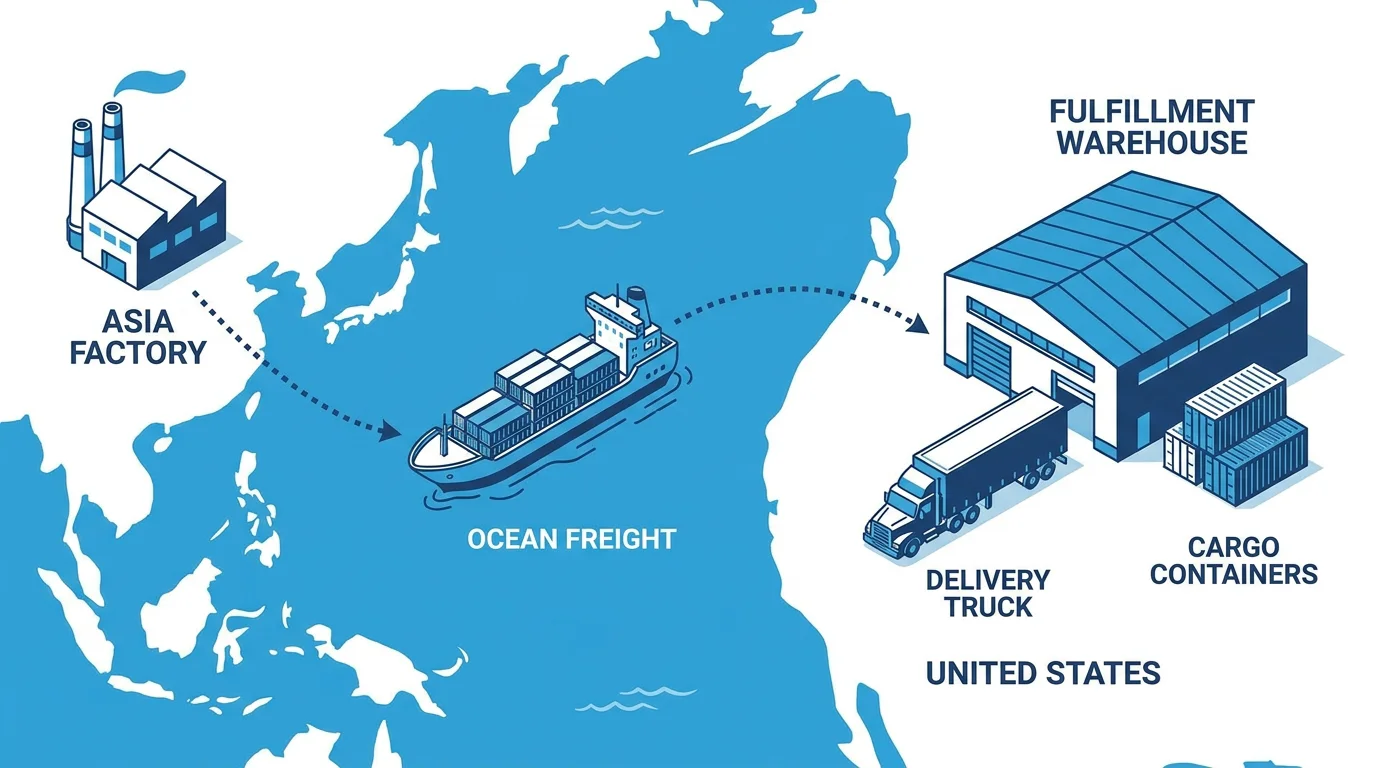
For the majority of US-based Amazon sellers sourcing products from Chinese manufacturers, the supply chain between the factory and the Amazon warehouse is where margins are won or lost. Choosing the right shipping method, managing customs documentation, and avoiding delays at the port of entry are non-negotiable competencies.
Four primary routes connect Chinese suppliers to US fulfillment centers: air freight (typically five to nine days), express ocean (22 to 28 days), rail (20 to 25 days), and standard ocean (30 to 40 days). Each option carries distinct cost and speed profiles. Selecting the wrong one for your product velocity can erode margins or leave you out of stock during peak demand. Our complete Amazon FBA shipping checklist helps first-time private label sellers plan each shipment step by step.
With Amazon eliminating prep services in March 2026, sellers now need a third-party logistics partner regardless of their fulfillment model. A dedicated freight forwarder that handles pickup, international transport, DDP customs clearance, and final delivery to the Amazon warehouse removes friction from a process that would otherwise demand significant time and expertise. For sellers unfamiliar with customs clearance documents for Amazon sellers, partnering with a specialist can prevent costly delays at the border.
Understanding Amazon Fees and Protecting Your Margins
Operating expenses now consume 88% of revenue for the average Amazon seller, according to marketplace analysis from early 2026. That number includes referral fees, FBA fulfillment charges, storage costs, advertising spend, and inbound placement fees. Maintaining profitability requires tracking every line item.
Monthly storage fees for standard-size items sit at roughly $0.78 per cubic foot, but they jump to $2.40 during the Q4 peak season. Sellers who do not plan inventory flow around these seasonal spikes risk watching their margins evaporate. Learning about costly FBA shipping mistakes to avoid is one of the fastest ways to reclaim lost profit.
Despite rising costs, more than 55% of small-to-mid-size Amazon businesses still report profit margins above 15%. 58% of sellers achieve profitability within 12 months, and 22% reach profitability in under three months. The sellers who hit these benchmarks share one trait: they treat cost management as a strategic discipline, not an afterthought.
Advertising: The Cost of Visibility
Advertising on Amazon is no longer optional; it is the cost of doing business. Amazon’s ad business grew 22% in Q4 2025, and annual ad revenue exceeded $68 billion in 2025. For sellers, this growth reflects the reality that organic visibility alone rarely drives enough sales to sustain a product launch or maintain ranking.
Average cost-per-click is projected at $1.18 to $1.25 in 2026, with category ranges from $0.89 in fashion to $2.50 to $7.00 or more in supplements and competitive health categories. A well-managed Sponsored Products campaign can deliver strong returns, but only when paired with conversion-optimized listings. A target ACoS of 15% to 25% and a TACoS of 10% to 15% are widely considered benchmarks for profitable campaigns.
The key takeaway: allocate advertising budget from day one. Sellers who launch without an ad strategy lose critical early momentum that is difficult to recover later.
Building a Brand on the Marketplace
Brand Registry is now used by over 800,000 brands in 2026. Enrollment is free, and it unlocks access to A+ Content, Sponsored Brands campaigns, and intellectual property protection tools. Brands that combine FBA with A+ Content are seeing an average 8% sales lift in 2026, demonstrating that logistics and branding work best as a unified strategy.
For private label sellers importing from China, brand building begins before the product reaches the customer. Consistent packaging, compliant labeling, and reliable delivery timelines all contribute to the customer experience. In 2026, Amazon’s algorithm heavily weights feedback from the last 30 to 60 days over legacy review histories, which means ongoing operational quality matters more than ever.
International Expansion and Cross-Border Opportunity
The US marketplace generates the highest revenue per seller, but international markets offer less competition and significant growth. The UK and EU marketplaces are less saturated in many categories than the US, particularly for private label brands entering with proper localization. Amazon now operates 22 global stores, with Ireland launching in 2025.
Around 60% of new sellers in the US make their first sale within the first year, compared with roughly 42% in Germany and 33% in the United Kingdom, according to Marketplace Pulse data analyzed by Seller Assistant. These differences highlight the importance of marketplace selection. However, for sellers already optimized in the US, expanding into Europe or Asia Pacific can diversify revenue streams and reduce dependence on a single market.
Cross-border logistics is the operational backbone of international expansion. A freight forwarder experienced in multi-country delivery, DDP documentation, and Amazon warehouse requirements across regions simplifies what would otherwise be an overwhelming compliance burden.
What Sets Profitable Amazon Sellers Apart
Competition on Amazon is becoming more professional. While the number of active sellers has declined in recent years, the number of million-dollar sellers continues to rise, meaning success increasingly depends on strong product sourcing, pricing strategies, and operational efficiency. The sellers who thrive in 2026 share several characteristics.
First, they treat their supply chain as a competitive advantage. Negotiating better freight rates, reducing lead times, and avoiding customs delays are not back-office tasks; they are margin-generating activities. Second, they invest in advertising strategically, scaling campaigns that deliver positive returns while cutting spend that does not convert. Third, they monitor fees relentlessly. Many Amazon FBA sellers in 2026 still report profit margins above 15%, and Amazon’s Perfect Order Percentage metric suggests top sellers maintain 95% or higher performance.
Finally, the most successful sellers choose partners who understand the Amazon ecosystem from end to end. From factory pickup in Shenzhen to final delivery at a US fulfillment center, having a single point of contact for logistics removes complexity and allows you to focus on growth.
Selling on Amazon in 2026 rewards operators who combine data-driven decisions with disciplined cost management. The marketplace is consolidating, but for prepared sellers, the opportunity per participant has never been larger. With third-party sellers generating over 60% of all paid units and over 100,000 sellers surpassing one million dollars in annual revenue, the ceiling is high for those who build the right foundation. A freight partner that manages your entire supply chain from China, including DDP customs clearance and final-mile delivery to Amazon warehouses, eliminates one of the largest operational headaches in the business. To get started, explore our complete FBA shipping checklist and request a free quote today.
Frequently Asked Questions
How much does it cost to start selling on Amazon in 2026?
A Professional selling account costs $39.99 per month plus selling fees. Most sellers start with less than $5,000 in total investment, covering inventory, initial advertising, and account fees. Working with a DDP freight forwarder like our team at QG Horizon can help you budget shipping costs upfront so there are no surprises.
Is Amazon FBA still worth it for new sellers?
Yes. FBA remains the preferred fulfillment method for approximately 78% of sellers because it provides Prime eligibility and significantly higher first-year earnings. However, you should account for rising fulfillment and inbound placement fees when calculating your product margins.
How long does it take to become profitable on Amazon?
According to marketplace data, 58% of sellers achieve profitability within 12 months, and 22% reach it in under three months. Profitability timelines depend on product selection, advertising strategy, and how efficiently you manage your supply chain and shipping costs.
Ready to Optimize Your Amazon Shipping?
Get 3 route options tailored to your products and timeline
Get Your Quote→