CPT Incoterm Definition: Carriage Paid To Explained 2026

Summary: Carriage Paid To (CPT) is an Incoterms rule under which the seller contracts and pays for transport to a named destination, while risk passes to the buyer much earlier, the moment goods reach the first carrier. It applies to any transport mode. Cost and risk transfer at two different points, a distinction that shapes every CPT contract.
How much of a shipment’s outcome can hinge on a single three-letter code? Under Carriage Paid To, the seller pays freight all the way to a named destination, yet the risk of loss or damage shifts to the buyer far earlier in the journey. That gap is precisely where costly misunderstandings begin, and our guide to the CPT Incoterm meaning unpacks it. Grasping the definition of the CPT Incoterm is essential for anyone negotiating international sales contracts.
The Incoterms rules were first introduced in 1936 by the International Chamber of Commerce, and the current edition, Incoterms 2020, provides the authoritative framework for allocating costs and risks across international transactions. Eleven rules exist, and CPT sits within the “C” family, where the seller pays for carriage but transfers risk at origin. For US businesses importing from overseas suppliers, that nuance carries real financial weight.
What the CPT Incoterm definition really means
At its core, the cpt incoterm definition is straightforward: the seller delivers the goods to a carrier of its choice and pays the freight required to move them to an agreed place of destination. However, the seller’s responsibility for risk ends much sooner than its responsibility for cost. Carriage Paid To applies to any mode of transport, including road, rail, air, sea, or a multimodal combination.
According to LexisNexis legal guidance, Carriage Paid To means the seller both delivers the goods and shifts the risk to the buyer by handing physical possession to the carrier in a manner suitable for the chosen transport mode. In a multimodal shipment, delivery is complete once the goods reach the first carrier. Everything after that point travels at the buyer’s risk, even though the seller’s invoice covers the freight.
This is the single most misunderstood feature of the rule. Many buyers assume that because the seller pays to the destination, the seller also carries the risk to the destination. That assumption is wrong, and it is worth reviewing the fundamentals in our overview of What is CPT in Incoterms? before signing any contract.
Two places that define every CPT agreement
Consider a contract that reads: “CPT International Airport of Dubai, Incoterms 2020.” A reader might assume risk stays with the seller until Dubai. In reality, it does not. A CPT agreement always involves two distinct locations, and confusing them is the classic error.
The first is the place of delivery, where the seller hands goods to the carrier. This is usually in the exporting country: a warehouse, a port of shipment, a departure airport, or a rail terminal. Risk transfers here. The second is the named place of destination, the point to which the seller must arrange and pay for transport, typically in the buyer’s country.
Because the citation names the destination but risk transfers at delivery, sellers and buyers are strongly encouraged to specify both points as precisely as possible in the sales contract. When these points are left undefined, the seller may choose the locations that best suit its own purpose, which rarely favors the buyer. Our summary of the CPT terms (overview) details how to word these clauses cleanly.
Seller and buyer obligations under CPT
Splitting duties correctly avoids disputes at the border. Under Carriage Paid To, the seller handles export clearance and the main carriage, while the buyer takes over import formalities and any transit-country customs procedures. As Shipping Solutions notes, some buyers do not realize that although the seller routes and pays the international carrier, the buyer carries the risk throughout the main carriage.
The table below breaks down who is responsible for each stage of a typical CPT shipment.
| Task | Seller | Buyer |
| Export packaging and marking | Yes | No |
| Export licenses and customs clearance | Yes | No |
| Delivery to first carrier | Yes | No |
| Main carriage / freight to destination | Yes | No |
| Risk during main carriage | No | Yes |
| Insurance (optional) | No | Yes |
| Import duties, taxes, and clearance | No | Yes |
| Onward delivery beyond destination | No | Yes |
Notice that insurance is nobody’s obligation under CPT. If the buyer wants cover for the main carriage, the buyer must arrange and pay for it, or negotiate it with the seller before the order is placed. That gap is exactly why the insured sibling rule, CIP, exists.
CPT compared with CIP and FCA
CPT rarely stands alone in a negotiation. Buyers weigh it against Carriage and Insurance Paid To (CIP) and Free Carrier (FCA), which share structural similarities. The essential differences are summarized below, with our own logistics service included for context.
| Rule | Seller pays freight | Insurance included | Risk transfers at |
| CPT | Yes, to destination | No | First carrier (origin) |
| CIP | Yes, to destination | Yes (ICC “A”, 110%) | First carrier (origin) |
| FCA | No | No | Named delivery point |
| QG Horizon DDP service | Yes, including duties and taxes | Arranged on request | Managed door to Amazon warehouse |
The distinction between CPT and CIP is only insurance: CIP requires the seller to buy cover at Institute Cargo Clauses “A” level for at least 110% of the contract value. FCA differs more sharply, because the seller does not pay the main freight at all. For a fuller walk-through, see our reference on Shipping terms for CPT. Where importers prefer a single all-inclusive figure with duties handled, a DDP arrangement removes the coordination burden entirely.
When to use CPT, and when to avoid it
CPT works well when the seller is ready to contract the carrier and cover transport to an agreed inland point, and when the buyer accepts that delivery is complete at origin. It suits overland and cross-border trade where the seller organizes carriage across multiple countries. For containerized ocean freight, however, the rule is trickier than it looks.
As Trade Finance Global observes, despite being recommended over the older CFR rule for container shipments, CPT is largely unworkable in practice for cross-ocean containers, because most buyers do not want to bear risk before the goods have actually been exported. Until the goods reach the border, the buyer may not even know when delivery occurred or which carrier is moving the cargo. That opacity is the central weakness of CPT for long-haul maritime trade.
The verdict for most importers is caution. Where the buyer lacks an agent at origin or a clear view of the carrier, a rule that transfers risk at the first carrier introduces avoidable exposure. Aligning the Incoterm with the actual route, and with who genuinely controls the shipment, matters more than the label itself.
CPT and Amazon FBA shipments from China
For Amazon FBA sellers moving inventory from China, CPT can leave you exposed. Risk passes at origin, insurance is unassigned, and you may not know your carrier or your true landed cost until goods are already in transit. Import duties and last-mile delivery to the Amazon warehouse fall on you. For sellers on tight timelines, that uncertainty is a liability.
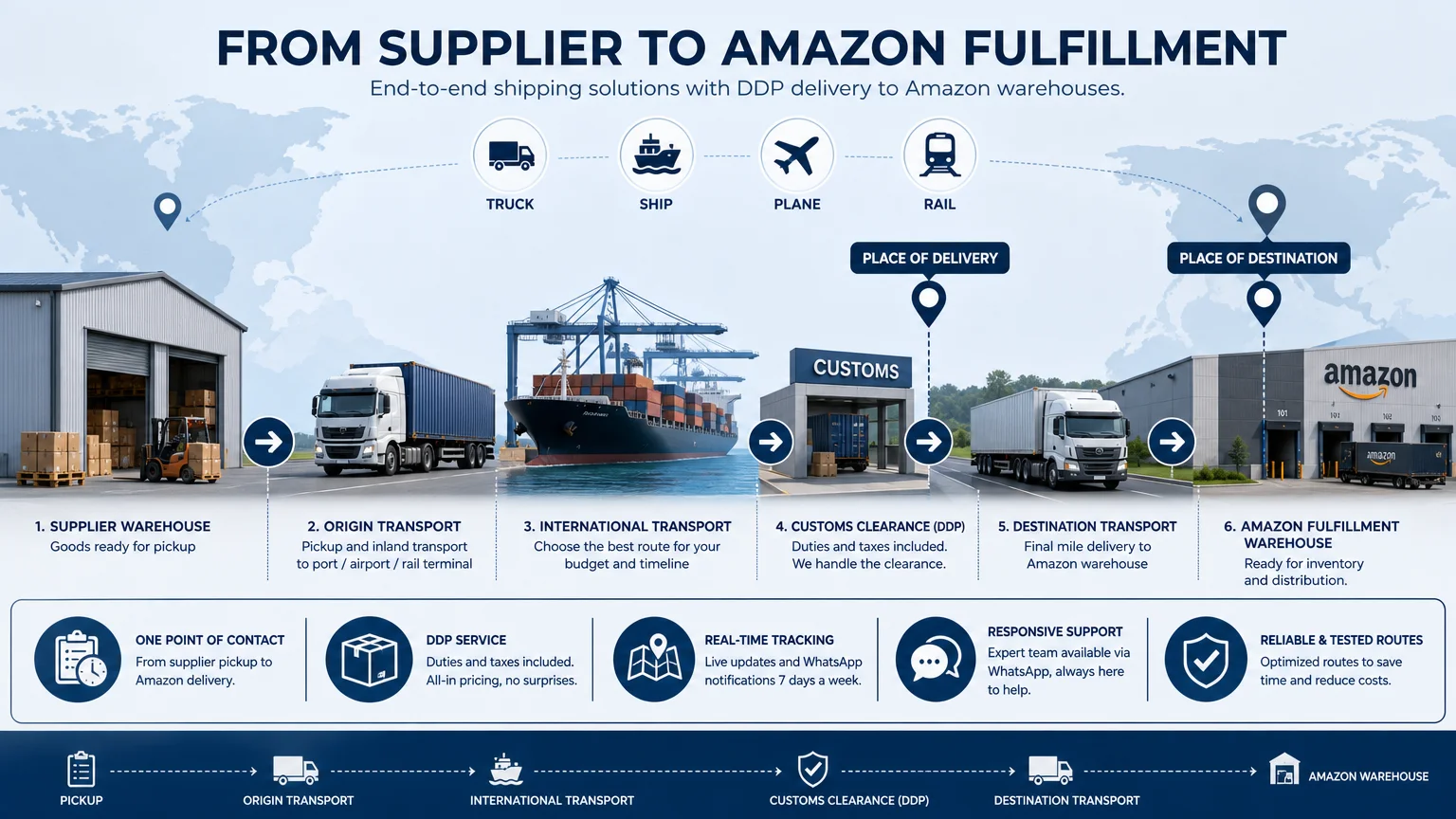
This is where we position our service differently. We collect from your supplier, handle export and DDP customs clearance with duties and taxes included, and deliver directly into the Amazon fulfillment center, so your all-inclusive price is known before the goods move. With real-time tracking and responsive WhatsApp support, you keep visibility that a bare CPT contract simply does not provide.
Final thoughts on Carriage Paid To
Understanding the CPT Incoterm and its definition comes down to one discipline: separate cost from risk. The seller pays the freight to a named destination, but the buyer inherits the risk the instant goods meet the first carrier, and no insurance is built in. Name both the delivery point and the destination precisely, decide who insures the main carriage, and match the rule to your real route. For containerized imports, weigh CPT carefully against alternatives that keep control closer to where you actually operate.
Take action with QG Horizon
If a CPT contract leaves you guessing about carriers, costs, or customs, you deserve a simpler path from factory to fulfillment. As Amazon sellers ourselves for more than five years, we understand where FBA shipments stall and how to keep yours moving on schedule.
Our team based in Shenzhen manages collection from your supplier, DDP clearance with duties and taxes included, and delivery straight to the Amazon warehouse, backed by real-time tracking and WhatsApp support. Request your free 24-hour FBA shipping quote with three route options and choose the one that fits your budget and timeline.
Frequently Asked Questions
Does the seller or buyer pay for freight under CPT?
The seller contracts the carrier and pays the freight all the way to the named place of destination. However, the buyer becomes responsible for costs that arise after the goods arrive, plus import duties and taxes.
When does risk transfer under a CPT agreement?
Risk transfers from seller to buyer the moment the goods are handed to the first carrier, typically in the exporting country. This happens well before the goods reach the named destination, which is a common source of confusion.
Is insurance included in CPT?
No. Neither party is obligated to insure the goods under CPT. If the buyer wants coverage for the main carriage, the buyer must arrange it independently or negotiate it with the seller before ordering.
What is the difference between CPT and CIP?
The only structural difference is insurance. Under CIP, the seller must provide cargo insurance at Institute Cargo Clauses “A” level for at least 110% of the contract value, whereas CPT leaves insurance entirely optional.
Is CPT a good choice for Amazon FBA imports from China?
CPT can leave FBA sellers exposed, since risk transfers at origin and duties fall on the buyer. Our DDP service collects from your supplier and delivers to the Amazon warehouse with duties included, giving you a known all-inclusive price instead.
Ready to Optimize Your Amazon Shipping?
Get 3 route options tailored to your products and timeline
Get Your Quote→