DAP Terms in Incoterms: A Complete Guide for US Importers
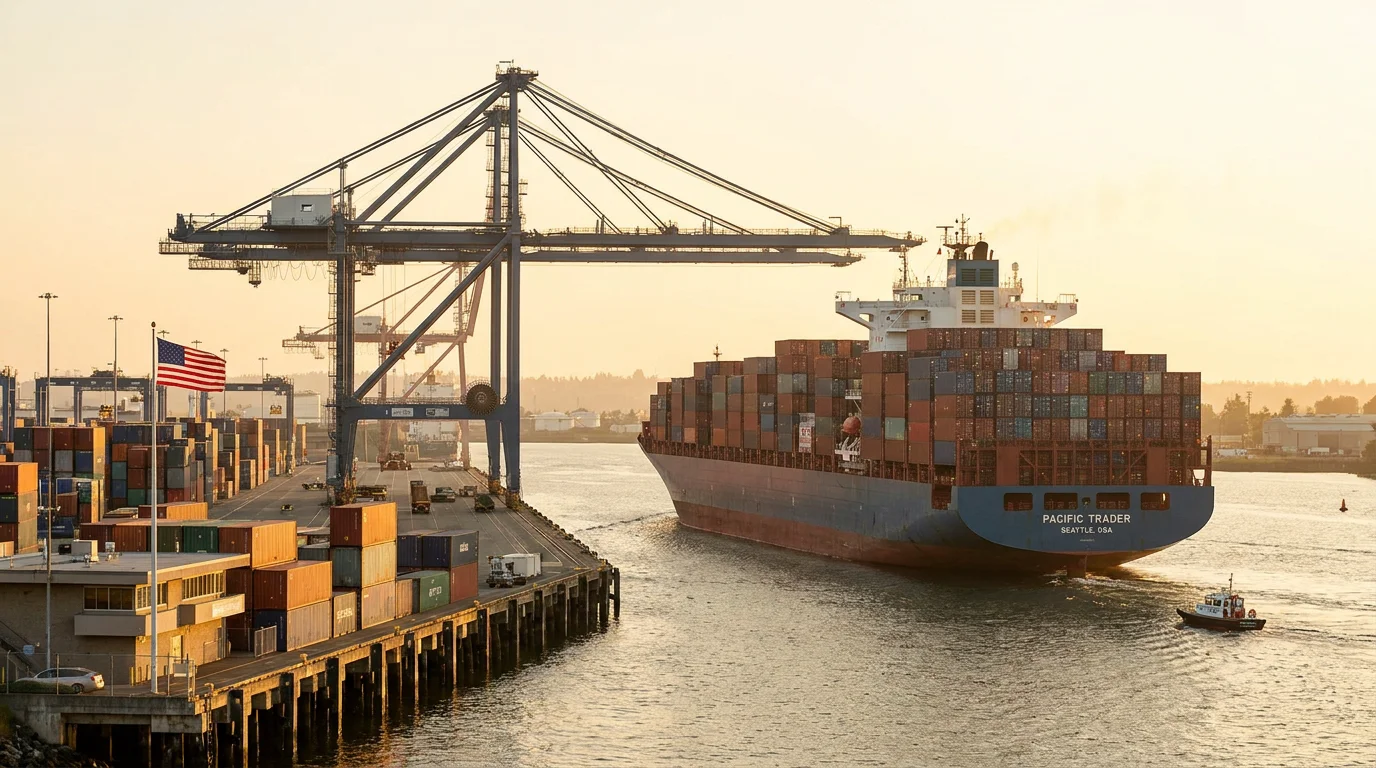
Summary: DAP (Delivered At Place) requires the seller to deliver goods to a named destination, ready for unloading, while the buyer handles import clearance and duties.
When goods cross borders, a single misunderstood clause can generate thousands of dollars in unexpected charges. This is exactly why mastering DAP terms in Incoterms matters for any business that imports products into the US. Whether you are sourcing inventory from China, Europe, or elsewhere, knowing who pays for what, and who bears the risk at each stage, is essential to protecting your margins. For a deeper dive into how this rule shapes real shipments, our guide on DAP in Incoterms breaks down each obligation step by step.
As of 2026, the ICC has not published any newer version of the Incoterms; the official rules in force remain Incoterms 2020, which took effect on January 1, 2020. The next revision is not expected until 2030, as the ICC follows a decennial update cycle. That means every contract you sign this year should reference Incoterms 2020 explicitly. Below, you will find a thorough breakdown of how DAP works, what obligations fall on each party, and when this rule serves US importers better than its alternatives.
What Does DAP Mean in International Trade?
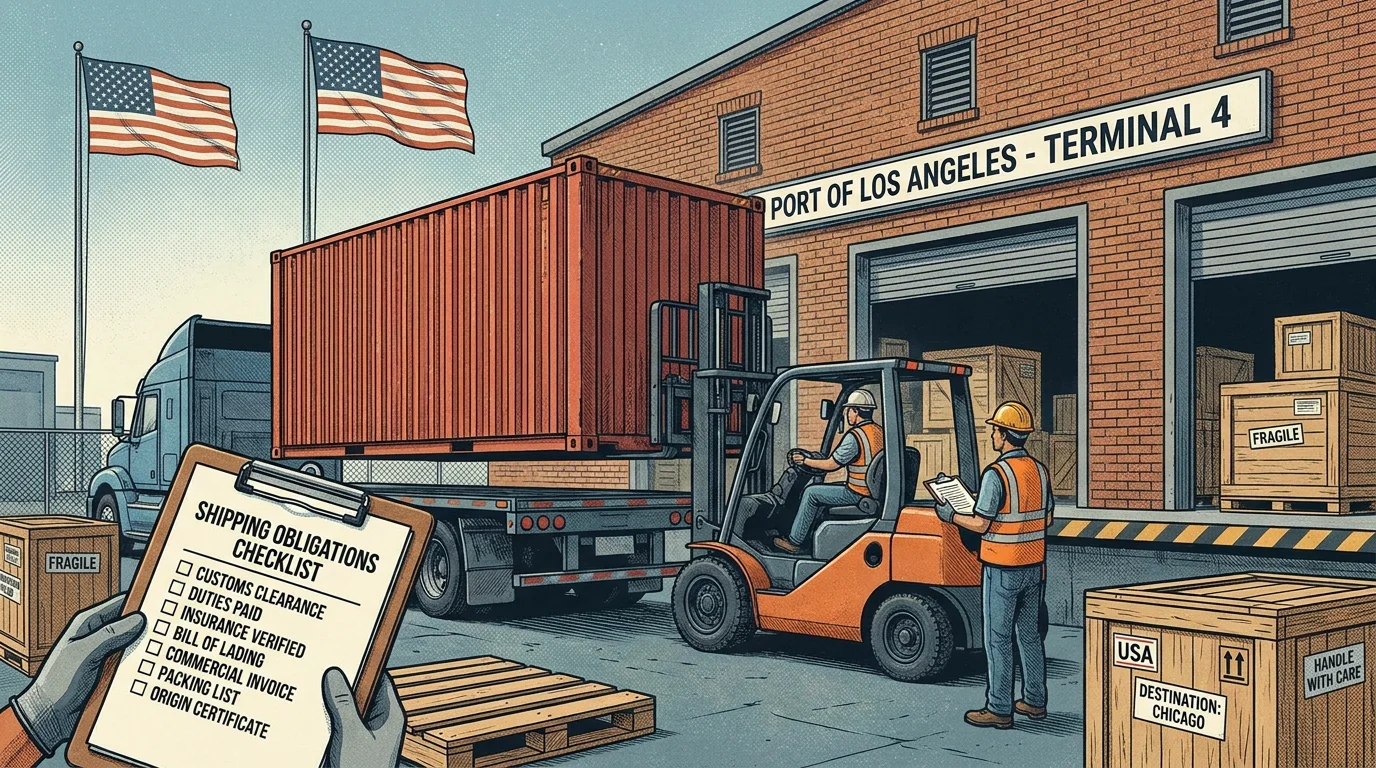
DAP, or Delivered At Place, is a versatile shipping agreement defined by the International Chamber of Commerce (ICC) that places the majority of the transport responsibility on the seller while leaving the final administrative steps to the buyer. In practice, the seller must get the goods to a precise, agreed destination, ready for unloading, at which point the risk transfers.
The DAP rule was first introduced in Incoterms 2010 and remains unchanged in the 2020 version; it replaced the former DDU (Delivered Duty Unpaid) term from the 2000 edition. Because it applies to any mode of transport, including multimodal shipments, DAP is well-suited to meet modern containerized and multimodal transportation practices.
One crucial detail that many importers overlook: “DAP Paris” is too vague; a proper clause should read something like “DAP Warehouse X, 12 Rue Y, 75001 Paris, France.” The same precision applies to US destinations. Specifying a full address prevents disputes over last-mile surcharges and delays, as noted by the Hayot Expertise Incoterms guide.
Seller Obligations Under DAP
Under DAP, the seller carries the bulk of the logistical burden. Understanding each obligation helps you evaluate whether a quoted price truly reflects all included costs.
- Goods and documentation: The seller must provide the commercial invoice, packing list, and any other agreed documents.
- Export clearance: The seller must complete and pay for export customs formalities as well as any customs formalities in transit countries through which the goods may pass.
- Carriage to destination: The seller must arrange and pay for transportation of the goods from their origin to the agreed destination.
- Risk during transit: The seller assumes the risk of loss or damage to the goods during transit, from origin to the agreed point of delivery.
- No insurance obligation: The seller has no obligation to the buyer to provide insurance, though prudent sellers typically insure the goods anyway.
The seller needs to be very careful pricing a DAP sale, accounting for all possibilities and potential problems, especially when part of the transport takes place within the buyer’s country after release from customs. For US importers, this means the seller’s quoted DAP price should cover everything up to the named delivery point, but not the duties, taxes, or unloading costs that follow.
Buyer Obligations Under DAP
As a buyer under DAP, your responsibilities begin the moment the goods arrive at the agreed destination. Here is what you need to handle.
- Import clearance: The buyer is responsible for taking delivery of the goods and for handling and paying for the import clearance process.
- Duties and taxes: The seller is not responsible for import customs clearance, VAT, excise duties, or import tariffs; the buyer assumes these costs.
- Unloading: The risk of unloading the goods from the arriving transport vehicle is the buyer’s responsibility, and if the unloading cost is not included in the seller’s transport contract, the buyer must bear this cost as well.
- Onward carriage: Any further transportation from the delivery point to your warehouse or store is at your expense.
For Amazon sellers importing from China into US fulfillment centers, the DAP structure means you will need to manage customs brokerage, pay US Customs duties, and coordinate final delivery to the Amazon warehouse yourself. If that sounds complex, a DDP (Delivered Duty Paid) arrangement may simplify the process. You can compare both approaches in our analysis of DDP vs DAP for Amazon FBA.
Where Does Risk Transfer Under DAP?
In DAP Incoterms, “delivery” and “destination” refer to the same concept: the named destination is both where goods are delivered and where the transfer of risk for loss or damage occurs. This is a critical distinction from “C” group Incoterms such as CIF or CIP, where the seller pays for carriage to the destination but risk transfers much earlier, at the point of shipment.
Incoterms rules in the “C” group do not require the seller to deliver goods to the destination; they mandate shipment from the designated port and payment of transportation costs. With “D” group rules such as DAP, the seller must ensure the goods actually arrive at the agreed destination, underscoring a higher level of responsibility. This is why the ICC Academy emphasizes that both DAP and DDP are true “arrival” contracts.
Under sub-article B3(a) of the Incoterms 2020 rules, the buyer bears all risks of loss or damage during the import clearance process. If the buyer is unwilling to assume this risk, the DDP rule should be used instead of DAP.
DAP Compared to Other Key Incoterms
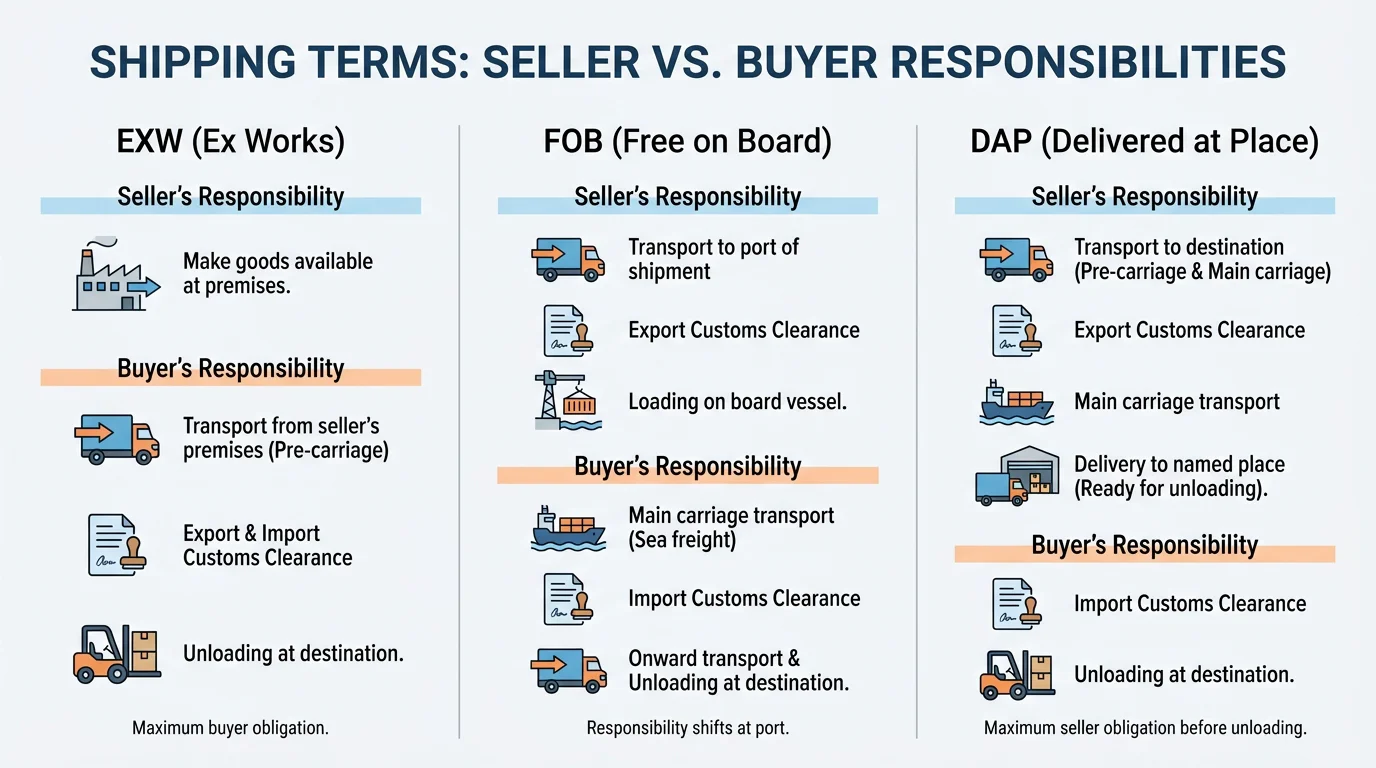
US importers frequently weigh DAP against DDP and FCA. The table below clarifies the key differences.
| Criterion | DAP | DDP | FCA |
|---|---|---|---|
| Risk transfer point | Named destination (before unloading) | Named destination (before unloading) | Seller’s premises or carrier pickup |
| Import clearance | Buyer | Seller | Buyer |
| Import duties and taxes | Buyer | Seller | Buyer |
| Main carriage cost | Seller | Seller | Buyer |
| Unloading at destination | Buyer | Buyer | Buyer |
| Best for (QG Horizon recommendation) | Importers who can manage customs | Sellers wanting an all-inclusive price | Buyers who prefer to control logistics |
DDP imposes the most obligations on the seller: they arrange and pay for transportation to the agreed destination, handle customs clearance, and pay any import duties in the destination country. If you want a fully landed cost with no surprises, DDP is typically the better choice. Our comparison of FOB vs CIF vs DDP Incoterms comparison explores this in greater detail.
FCA, on the other hand, transfers risk much earlier. Under Incoterms 2020, the 11 rules are grouped into two categories: seven for any mode of transport and four exclusively for sea, inland waterway, or land transport. DAP and FCA both belong to the “any mode” category, but they allocate responsibilities very differently. For a thorough look at FCA, see our resource on FCA terms in Incoterms.
Common Mistakes US Importers Make With DAP
Even experienced buyers fall into predictable traps when using DAP. Here are the most frequent errors and how to avoid them.
Vague destination descriptions. Vague destination strings lead to expensive litigation and redirected haulage fees; precise wording ensures the carrier’s quote is accurate and prevents “out of area” surcharges. Always specify a full street address, zip code, and the notation “Incoterms 2020” in your contract.
Assuming the seller covers duties. The buyer is responsible for all import customs clearance procedures and associated taxes; under DAP, the seller’s obligation ends when the goods are ready for unloading at the destination. Forgetting this can result in goods sitting in customs while you scramble to arrange a broker.
Confusing DAP with DPU. Under DAP the seller does not unload the goods, whereas under DPU (Delivered at Place Unloaded), the seller does unload the goods. According to the ICC’s official Incoterms 2020 page, this is the sole operational difference between the two rules.
Ignoring insurance. Neither party is contractually required to insure the goods under DAP. However, given that the seller bears risk until the named destination, most sellers purchase cargo insurance. As a buyer, verify this explicitly; do not assume coverage exists.
When DAP Makes Sense for Your Business
DAP is often the right choice when you have established customs brokerage relationships in the US and want to retain control over the import process. It can also be advantageous when your seller is located far from the destination and can negotiate competitive freight rates.
In practice, DAP places most of the logistical burden on the seller, making it, alongside DDP, one of the preferred Incoterms for exporters who want to offer a high level of service. From the buyer’s perspective, this means you benefit from door-level delivery without paying the premium that a DDP arrangement sometimes includes for the seller’s import compliance services.
However, if you are an Amazon FBA seller shipping from China and you want a single, predictable landed cost, DDP usually eliminates more friction. With a DDP arrangement, your freight forwarder handles customs, duties, and final delivery as part of one quote. That is the model we use at QG Horizon for most of our clients, and you can learn more about the cost benefits in our guide to DDP shipping for Amazon FBA.
How to Specify DAP Correctly in Your Contracts
Contracts signed in 2026 must explicitly reference “Incoterms 2020” to avoid any legal ambiguity. Simply writing “DAP” without the version and a precise location invites disputes. According to the US International Trade Administration, the Incoterms are a set of 11 individual rules issued by the ICC that define the responsibilities of sellers and buyers, and each rule clarifies the tasks, costs, and risks to be borne by both parties.
A correctly drafted DAP clause in a US import contract should include the following elements.
- The three-letter code: DAP.
- The full address of the named destination (for example, “Warehouse 7, 1200 Commerce Blvd, Los Angeles, CA 90001, USA”).
- The version reference: Incoterms 2020.
- Any additional agreements about unloading costs, insurance, or documentation.
All contracts using Incoterms are valid if agreed upon by all parties and correctly identified on export-related documents; although the ICC recommends Incoterms 2020, parties may use earlier versions as long as they clearly specify the chosen version.
Conclusion
Choosing DAP terms in Incoterms gives US importers a practical balance: the seller handles the heavy lifting of international freight and transit risk, while the buyer retains control over import clearance and duties at the destination. The key to using DAP effectively is precision; always specify a complete delivery address and reference Incoterms 2020 in every contract. Remember that DAP does not cover import duties, taxes, or unloading, so factor those costs into your landed cost calculations from the start.
For Amazon FBA sellers who ship from China and prefer a fully managed, all-inclusive freight solution that covers customs clearance and delivery to the warehouse, we handle every step of the process under a single quote. Explore our DDP shipping service for Amazon FBA and see how a streamlined logistics partner can reduce your costs and eliminate surprises.
Frequently Asked Questions
Does DAP include import duties for goods entering the US?
No. Under DAP, the buyer is responsible for all import duties, taxes, and customs clearance in the destination country. If you want those costs included in the seller’s price, you should use DDP instead. QG Horizon offers DDP solutions that bundle duties, taxes, and delivery into a single predictable quote.
Can DAP be used for shipments by sea, air, or rail?
Yes. DAP applies to any mode of transport, including multimodal shipments. Whether your goods travel by ocean freight, air cargo, or rail, the rule works the same way: the seller delivers to the named place, and the buyer handles unloading and import formalities.
What is the difference between DAP and DPU?
The sole difference is unloading. Under DAP, the buyer is responsible for unloading the goods at the destination. Under DPU (Delivered at Place Unloaded), the seller must unload the goods and bear the associated risk. If you lack unloading equipment at your facility, DPU may be more appropriate.
Ready to Optimize Your Amazon Shipping?
Get 3 route options tailored to your products and timeline
Get Your Quote→