What Ex Works Price Means: A Complete EXW Pricing Guide
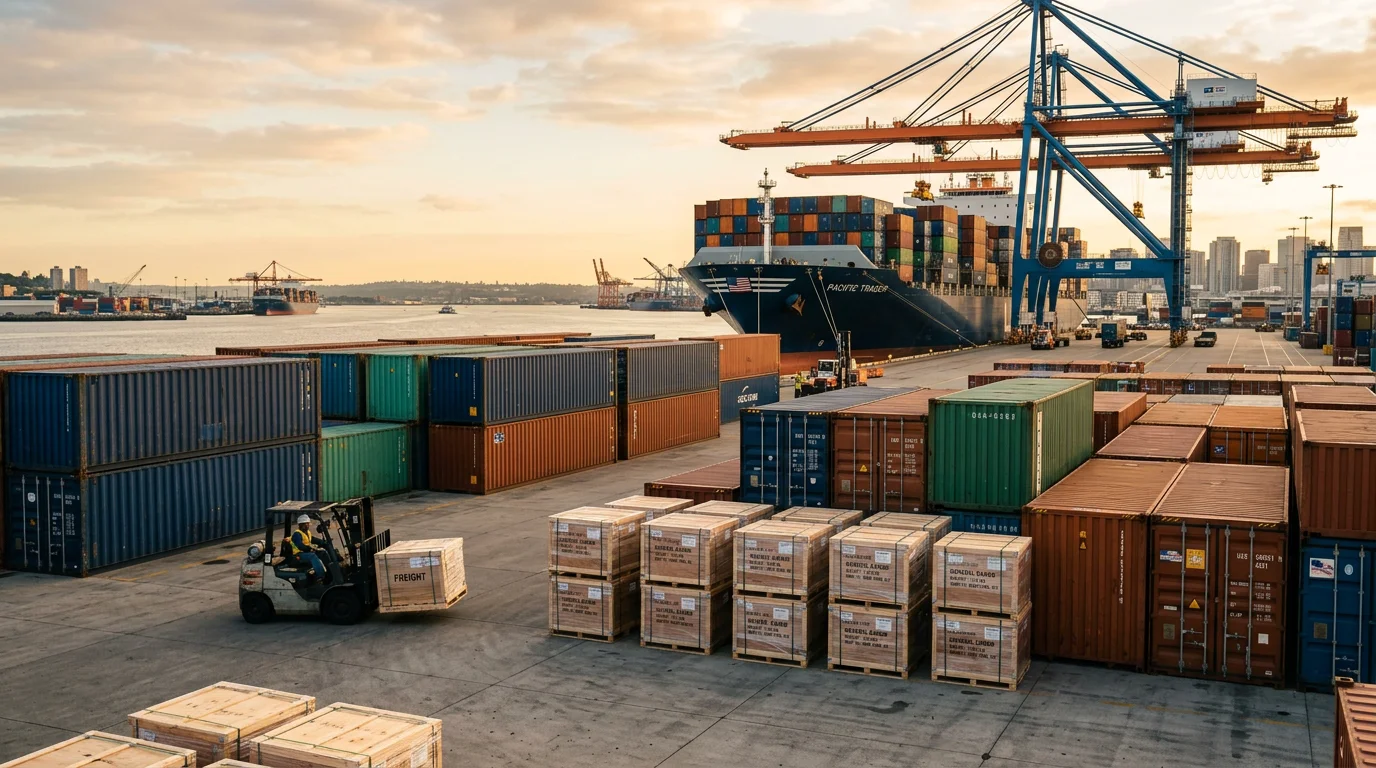
Summary: An ex works price covers only the cost of the goods at the factory gate, including production, packaging, and the supplier’s margin. It excludes loading, inland transport, export clearance, freight, insurance, and import duties. Under this Incoterm, the buyer assumes nearly every cost and risk once the goods are made available for collection.
A single number on a supplier quotation can be deceiving. When a factory in Shenzhen offers a rate labeled EXW, that figure may represent barely half of what you eventually pay to land a shipment in an American warehouse. Knowing what the ex works price means is therefore the difference between an accurate budget and a costly surprise. Our EXW pricing breakdown exists precisely because so many importers misread this term.
Ex Works sits at one end of the international trade spectrum. ICC Academy notes that EXW represents minimal obligations for the seller and maximum responsibilities for the buyer. For US businesses sourcing overseas, that imbalance shapes every cost calculation that follows.
What the Ex Works Price Actually Covers
Understanding what the ex works price means starts with a narrow definition. The figure reflects the value of the goods at the manufacturing site and nothing beyond it. Typically, this price bundles the supplier’s research, production, and packaging costs together with a certain profit margin. It is, in plain terms, a factory-gate price.
Under Ex Works, the seller’s duty is limited. Legal analysis of Incoterms 2020 explains that the seller’s job ends the moment goods are made available at their premises for pickup, after which the buyer owns every cost and risk. The supplier must simply produce conforming goods, package them suitably, and notify you that they are ready for collection.
This makes the EXW figure the cleanest possible baseline. It contains no transport, no clearance, and no freight markup. If you want to compare two suppliers on manufacturing value alone, the ex works quote is the honest comparison point.
The Costs the EXW Price Leaves Out
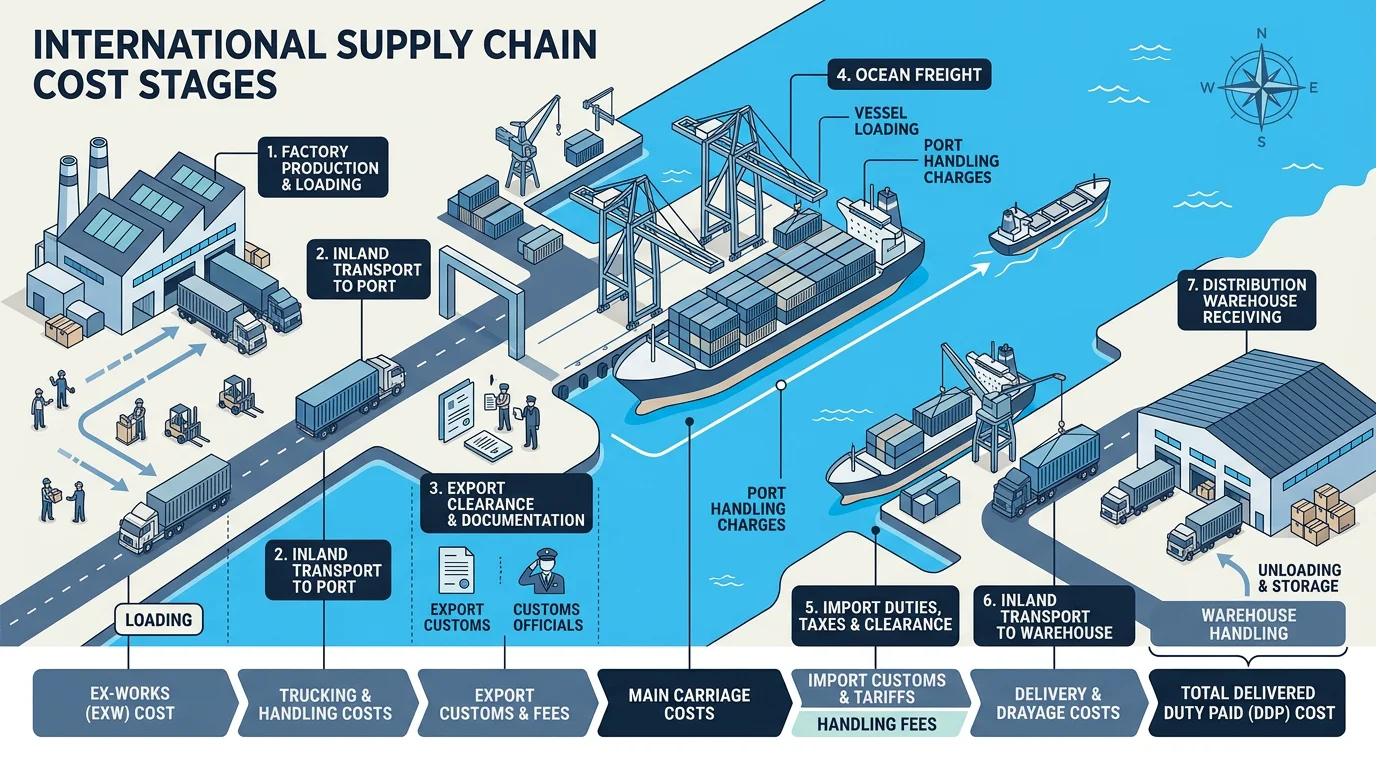
Here is where many first-time importers stumble. The costs that fall outside an EXW quote are numerous, and they accumulate quickly. According to Trade Finance Global, the buyer pays for loading charges, delivery to port, export duties and taxes, origin terminal charges, carriage, destination terminal charges, delivery to destination, and import duty and taxes.
In practice, the buyer’s cost stack under Ex Works includes the following:
- Loading at origin, which the seller has no obligation to perform.
- Inland transport from the factory to the port of departure.
- Export clearance and associated documentation.
- Ocean or air freight to the destination country.
- Cargo insurance across the full journey.
- Import duties, taxes, and customs clearance on arrival.
- Final delivery to the receiving warehouse.
Each of these items carries its own price and its own risk. If you would like the full mechanics of who handles what, our guide to EXW shipping terms maps every stage in sequence.
Who Pays for What Under Ex Works
Imagine a container of goods sitting on a loading dock in Guangdong. From that moment, responsibility is almost entirely yours. Risk transfers at a single, precisely defined point: when the goods are made available at the agreed location, ready for your collecting vehicle. If a forklift damages a pallet during loading, the buyer absorbs the loss.
The table below contrasts EXW with two Incoterms that shift more of the burden onto the seller, so you can see where the ex works price sits.
| Responsibility | EXW (Ex Works) | FOB (Free on Board) | DDP (Delivered Duty Paid) |
|---|---|---|---|
| Goods at factory | Buyer collects | Seller handles | Seller handles |
| Export clearance | Buyer | Seller | Seller |
| Main freight | Buyer | Buyer | Seller |
| Import duties and taxes | Buyer | Buyer | Seller |
| Delivery to final warehouse | Buyer | Buyer | Seller |
The pattern is clear. As Export Development Canada describes it, Ex Works places minimal responsibility on the seller beyond making goods available at an agreed time and place. Everything downstream is negotiated, arranged, and paid for by the buyer.
Why the Export Clearance Problem Matters
One risk deserves special attention because it is frequently overlooked. Under a strict reading of EXW, the buyer is responsible for export formalities in the seller’s own country. That is a legal and practical obstacle.
For cross-border shipments, the ICC itself encourages traders to consider alternatives such as FCA, because the seller often cannot legally file the export declaration in a country where the buyer has no presence. In many jurisdictions the exporter of record must be established locally. This is why experienced logistics teams frequently convert a nominal EXW arrangement into a managed pickup that behaves more like FCA in practice.
For an importer without local agents at origin, this single clause can stall a shipment entirely. Our explainer on the EXW shipment term covers how this is resolved on the ground in China.
Ex Works Pricing and Amazon FBA Sellers

For sellers shipping into Amazon fulfillment centers, an EXW quote is tempting because it looks low. That low number, however, hides the entire logistics chain that FBA requires: pickup, freight, clearance, and delivery straight to the warehouse door. A quote that ignores those steps is not a budget; it is a starting point.
This is where a specialist forwarder earns its place. Rather than manage export clearance, freight bookings, and customs bonds alone, you can consolidate the process with a single partner. We handle collection at your supplier, arrange a route that fits your budget and timeline, and deliver under DDP so that duties and taxes are included in one all-inclusive figure known in advance. That converts a fragmentary EXW price into a predictable landed cost.
The distinction is not academic. EXW remains a controversial choice for US exporters and importers, and rising scrutiny around export compliance makes an unmanaged ex works arrangement riskier than the headline price suggests.
How to Turn an EXW Quote Into a Landed Cost
Never accept an ex works number as your true purchase cost. To reach a landed cost, add each downstream expense to the factory-gate figure. A disciplined method looks like this:
- Start with the EXW unit price multiplied by quantity.
- Add inland haulage from factory to port.
- Add export clearance and origin terminal charges.
- Add international freight for your chosen mode.
- Add insurance for the full transit.
- Add US import duties, tariffs, and customs fees.
- Add final delivery to your warehouse or fulfillment center.
Only when every line is filled do you know your real cost per unit. Correct tariff classification is essential here, because misclassification can trigger penalties on arrival in the US market. Treating the EXW figure as the whole story is the single most common budgeting error importers make.
Final Thoughts on Reading an EXW Quote
Knowing what the ex works price means protects your margins. The number represents the goods at the factory gate and nothing more, so every cost from loading to final delivery remains yours to plan and pay. Read each EXW quote as a baseline, build the full cost stack around it, and pay close attention to export clearance obligations that Ex Works quietly assigns to the buyer. Do that consistently, and a term often described as risky becomes a transparent, controllable foundation for your sourcing decisions.
Take action with QG Horizon
You now understand why an ex works quote is only the first line of a much longer cost sheet. The real challenge is turning that factory-gate figure into a shipment that reaches your Amazon warehouse on time and on budget. That is the exact gap we close for sellers importing from China.
As a forwarder run by Amazon sellers ourselves, we provide a quote within 24 hours with three route options across air, sea, and China to Europe rail. We collect from your supplier, clear customs under DDP with duties and taxes included, and deliver directly to the fulfillment center, with real-time tracking and WhatsApp support seven days a week. Request your free FBA shipping quote and replace guesswork with an all-inclusive price known in advance.
Frequently Asked Questions
Does the ex works price include shipping?
No. An ex works price covers only the goods at the factory. Shipping, loading, export clearance, freight, and import duties are all paid separately by the buyer.
Is EXW cheaper than FOB or DDP?
The EXW figure looks cheaper because it excludes almost every logistics cost. Once you add freight, clearance, and duties, the total often matches or exceeds a fully managed DDP quote that already bundles those charges.
Who is responsible for export clearance under EXW?
Formally, the buyer is responsible for export formalities in the seller’s country. Because a foreign buyer often cannot legally act as exporter of record, this step usually requires a local agent or a forwarder to arrange it.
Is Ex Works a good choice for Amazon FBA sellers?
EXW suits importers with reliable agents at origin. Many FBA sellers lack that network, so a service like ours that handles pickup, freight, and DDP delivery to the warehouse removes the risk while keeping costs predictable.
How do I calculate the real cost of an EXW purchase?
Start with the ex works price, then add inland transport, export clearance, international freight, insurance, import duties, and final delivery. The sum is your landed cost, which is the only figure you should use for pricing decisions.
Ready to Optimize Your Amazon Shipping?
Get 3 route options tailored to your products and timeline
Get Your Quote→