FCA Shipping Term Meaning: Free Carrier Rules Explained
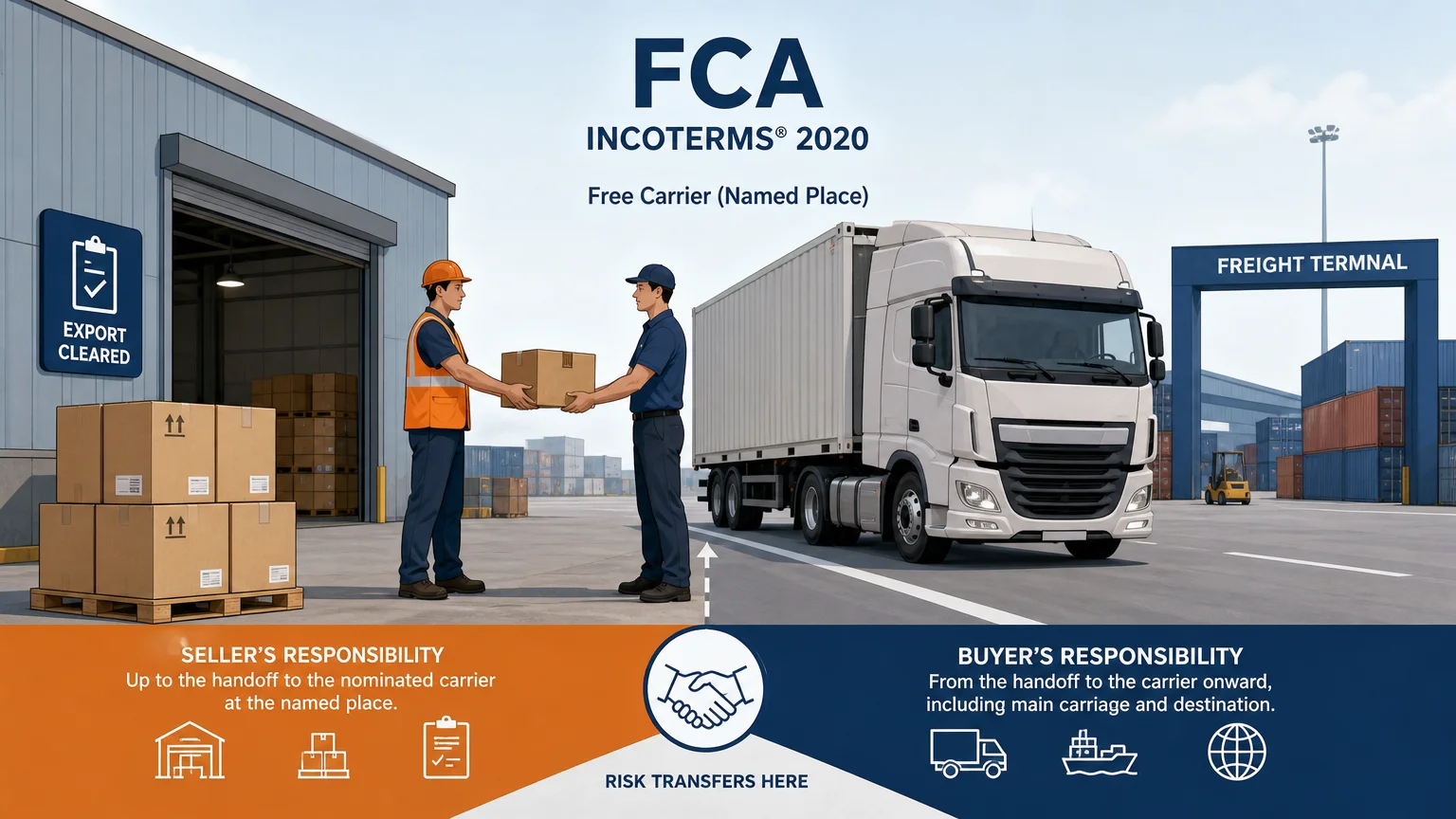
Summary: The FCA shipping term meaning is Free Carrier, an Incoterms® rule in which the seller delivers export-cleared goods to a carrier or another party nominated by the buyer at a named place. The seller handles delivery and export clearance, while the buyer usually arranges main transport, import clearance, insurance, duties, and onward delivery after the agreed handoff.
A single location in a sales contract can determine who carries the risk for an entire shipment. If you are reviewing a supplier quotation, our FCA terms meaning resource can help you understand the responsibilities before you approve the order.
The fca shipping term meaning is more specific than “the seller sends the goods.” FCA defines where delivery takes place, when risk transfers, which party manages export clearance, and who arranges transport beyond the named handoff point. For US importers and e-commerce sellers, those details can affect landed cost, insurance decisions, customs planning, and shipment control.
What does FCA mean in shipping?
FCA stands for Free Carrier. Under this Incoterms® 2020 rule, the seller delivers the goods to a carrier or another person nominated by the buyer at a named place. The goods must be prepared for export, and the seller normally completes the export clearance required in the country of origin.
The buyer chooses or nominates the carrier and generally arranges the main carriage from the delivery point. The buyer also manages import formalities at destination, including applicable duties, taxes, permits, and customs requirements. The precise allocation depends on the sales contract and the exact named place written after FCA.
Incoterms® rules clarify delivery tasks, costs, and risks between the parties. The U.S. trade guidance lists FCA among the rules that can be used with any mode of transport, unlike rules reserved for sea and inland waterway transport.
FCA can therefore be used for road, rail, air, ocean, or multimodal shipments. It is especially useful when the buyer wants control over the main transport while the seller remains responsible for export procedures and the initial delivery to the carrier.
Where does FCA delivery and risk transfer happen?
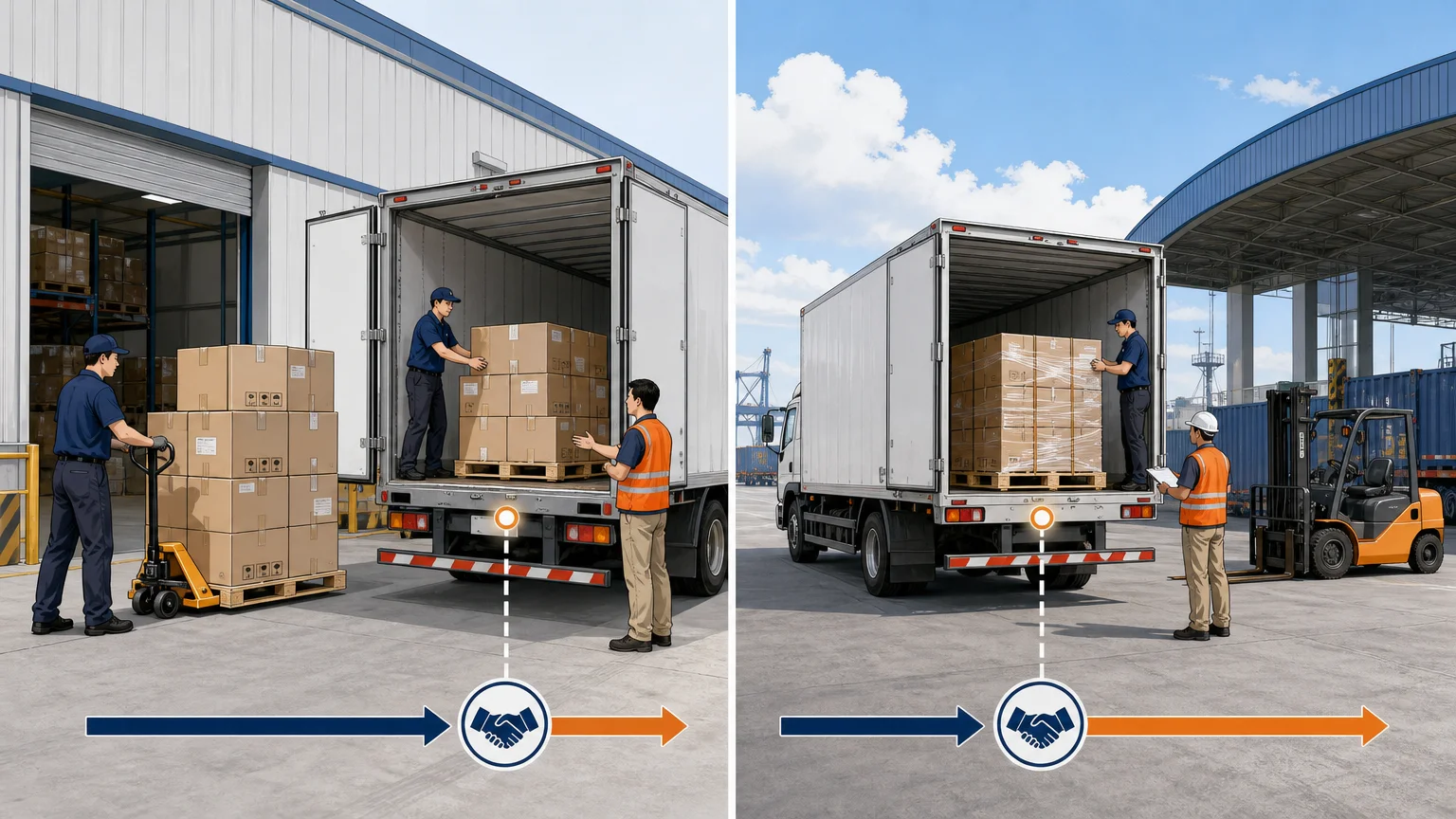
The named place is the most important practical detail in an FCA clause. Writing only “FCA United States” or “FCA Shenzhen” does not identify the operational handoff precisely enough. The contract should identify the facility, terminal, warehouse, loading dock, or other agreed point.
FCA has 2 delivery scenarios:
- Seller’s premises: The seller delivers when the goods are loaded onto the collecting vehicle provided by the buyer or the buyer’s carrier.
- Another named place: The seller delivers when the goods are placed at the disposal of the buyer’s carrier on the seller’s arriving vehicle, ready for unloading. The seller is generally not responsible for unloading at that location.
Risk transfers when delivery has occurred under the applicable scenario. If the named place is the seller’s warehouse, the loading operation is part of the seller’s delivery responsibility. If the named place is a terminal or forwarder’s facility, the contract should make clear whether the seller’s vehicle is unloaded by the receiving party.
For a practical explanation of how the named point changes the handoff, see our FCA shipping point article. The key principle is simple: the named place is not merely an address. It identifies the point at which the seller has completed delivery and the buyer assumes the transit risk.
Who pays the costs under FCA?
FCA does not mean that the seller pays every shipping expense. It divides the costs around the delivery point. The seller pays costs up to delivery, while the buyer normally pays costs after delivery.
The seller generally handles:
- Export-appropriate packaging and marking.
- Quality, quantity, measurement, weighing, and other delivery checks.
- Transport to the named delivery point when required.
- Loading onto the buyer’s collecting vehicle when delivery occurs at the seller’s premises.
- Export licenses, export declarations, and other export customs formalities.
- Costs associated with providing customary proof of delivery.
The buyer generally handles:
- The main international carriage after the named delivery point.
- Transit costs after delivery, unless the parties agree otherwise.
- Cargo insurance, although insurance is not automatically mandatory under FCA.
- Import licenses, import customs clearance, duties, taxes, and destination requirements.
- Delivery from the arrival point to the final destination.
- Unloading at the named place when the seller delivers there on its arriving vehicle.
The price quoted under FCA should therefore be read together with the named place. A quotation for FCA at a supplier’s warehouse differs from a quotation for FCA at an export terminal because the seller may incur additional local transport and handling costs in the second arrangement.
How is FCA different from EXW and FOB?
EXW and FOB are often mentioned alongside FCA, but they transfer responsibility at different points. Choosing the wrong rule can create uncertainty about export clearance, loading, insurance, and the moment of risk transfer.
The ICC Academy explanation distinguishes FCA from EXW by focusing on export clearance and the seller’s delivery responsibility. FCA generally requires the seller to clear the goods for export, while EXW places more responsibility on the buyer from the seller’s premises.
- FCA: The seller clears the goods for export and delivers them to the buyer’s nominated carrier at the named place. It works with any mode of transport.
- EXW: The seller makes the goods available at the named premises. The buyer usually arranges loading, export clearance, transport, and other steps from that point.
- FOB: The seller delivers the goods on board the vessel at the named port of shipment. FOB is designed for sea and inland waterway transport, not general air, road, rail, or multimodal use.
FCA is often more practical than EXW for international purchases because the seller is responsible for export formalities. This matters when the buyer is located in the US and may not have the local registrations, customs knowledge, or operational presence needed to manage export clearance in the seller’s country.
FCA also differs from FOB because risk transfers at the carrier handoff rather than when the goods are loaded on board a vessel. For containerized shipments, the handoff to a carrier or terminal often occurs before the container reaches the vessel. The contract should reflect the actual logistics process.
Why does the named place matter for China to US shipments?
Consider a US seller purchasing cartons from a supplier in China. If the contract states FCA at the supplier’s warehouse, the seller may become responsible for the main carriage once the supplier loads the buyer’s nominated truck. If the contract states FCA at a named freight terminal, the supplier may first arrange transport to that terminal, complete export formalities, and deliver the goods there.
The cost and risk can change even when the product price remains identical. A vague clause may leave the parties disputing who pays for local trucking, terminal handling, loading, storage, or damage before the international journey begins.
Before accepting an FCA quotation, specify:
- The exact facility name and full address.
- The delivery date or agreed delivery window.
- The nominated carrier and its contact details.
- Whether delivery occurs at the seller’s premises or another location.
- Who loads or unloads the goods at the named place.
- Which party books the main transport.
- Which proof of delivery or transport document the seller must provide.
- Which version of the Incoterms® rules applies.
Our FCA delivery definition explains why delivery should be connected to a specific operational point rather than a broad city or country name. Clear wording is particularly important when goods move from Chinese suppliers through several transport stages before reaching a US warehouse or Amazon fulfillment destination.
What should an FCA contract or purchase order include?
A short purchase order can still contain a precise FCA clause. The usual format is “FCA, exact named place, Incoterms® 2020.” The more complex the shipment, the more detail should accompany that wording.
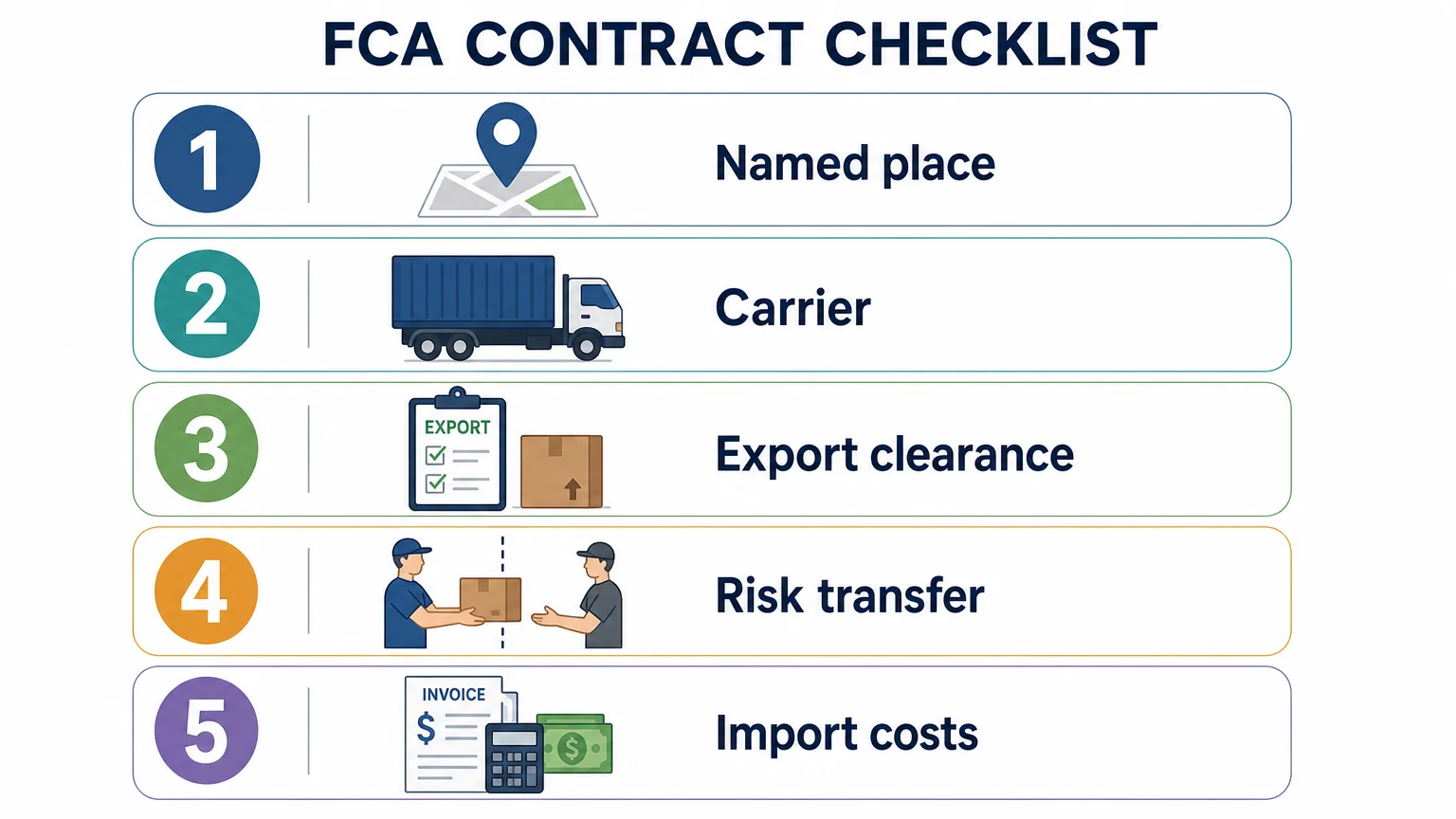
At a minimum, confirm the following before the order is released:
- Name the handoff: Identify the precise facility, terminal, warehouse, or loading point.
- Confirm the carrier: Give the seller the carrier’s identity, collection instructions, and booking information.
- Assign export work: Confirm that the seller will complete export clearance and provide required documents.
- Record risk transfer: State the delivery event that transfers the risk of loss or damage.
- Review destination costs: Allocate main freight, insurance, import clearance, duties, taxes, and final delivery.
Incoterms® 2020 also includes a mechanism that can help when the seller needs an on board bill of lading for a letter of credit. The parties must agree on the requirement, and the buyer can instruct its carrier to issue the relevant transport document after loading. This does not move the FCA delivery point or automatically transfer the seller’s responsibility beyond that point.
Legal guidance on the FCA rule also emphasizes that the named place determines how delivery occurs and when the seller’s risk ends. The LexisNexis guidance is useful when a contract requires more detailed review than a basic shipping quotation.
How does FCA compare with a DDP freight-forwarding service?
FCA and DDP describe different responsibility structures. Under FCA, the buyer normally controls the main carriage and manages import formalities after the named handoff. Under DDP, the seller or logistics provider takes responsibility for delivery to the named destination, import clearance, and applicable duties and taxes.
Our China to Amazon warehouse service is structured around DDP freight forwarding rather than a direct FCA offer. We coordinate supplier pickup, Chinese export declaration, international air, fast boat, ocean, or rail freight, destination customs clearance, DDP duties and taxes, door to door delivery, tracking, and shipment support.
This distinction matters for Amazon FBA sellers. A seller using FCA may need to coordinate several parties after the supplier hands over the goods. A seller using our DDP service can submit product information or a packing list, compare route options, select a route based on urgency and budget, and follow key shipment stages through tracking and WhatsApp updates.
The choice should follow the shipment’s actual needs. FCA may suit a buyer with established carrier relationships and strong control over international logistics. A coordinated DDP service may be more suitable when the seller wants one provider to manage supplier pickup, customs, duties, and delivery to an Amazon warehouse. The commercial quotation should state the selected structure clearly.
What are the practical advantages and limitations of FCA?
FCA offers a balanced allocation of responsibility, but it does not remove the buyer’s logistics obligations. Its main advantage is flexibility. The buyer can nominate the carrier, negotiate main freight, select the transport mode, and control the onward route.
FCA also gives the seller responsibility for export clearance. That can reduce the risk of asking a foreign buyer to complete procedures in the seller’s country. The seller remains involved in the origin process without paying for the entire international journey.
The main limitation is that the buyer assumes risk earlier than under destination terms such as DAP or DDP. The buyer may also need to arrange insurance, monitor the shipment, manage import clearance, pay duties and taxes, and resolve destination delivery issues.
FCA works best when both parties understand the handoff and have the operational ability to perform their assigned tasks. It becomes less attractive when the buyer wants a single provider to manage the entire route from supplier pickup through final delivery.
FCA shipping term meaning in practice
The meaning of FCA in shipping is a defined handoff, not simply a low freight price. The seller delivers export-cleared goods to the buyer’s nominated carrier at a precisely named place, then the buyer usually assumes the main transport, import clearance, destination costs, and transit risk. Before signing, specify the place, carrier, loading method, documents, insurance position, and Incoterms® version. That precision helps US buyers avoid avoidable disputes and compare FCA with EXW, FOB, or DDP on a like for like basis.
Plan Your China to Amazon Shipment
If FCA leaves your team responsible for several separate logistics stages, a coordinated service can simplify supplier pickup, international freight, customs handling, and Amazon warehouse delivery.
We provide route options across air, fast boat, ocean, and rail, with DDP customs handling, shipment tracking, and support for sellers shipping from China to Amazon warehouses. Request details about our FCA shipping services and compare the structure that fits your shipment volume, urgency, destination, and budget.
Frequently Asked Questions
What does FCA mean in shipping?
FCA means Free Carrier. The seller delivers export-cleared goods to a carrier or another party nominated by the buyer at a named place, and risk normally transfers at that delivery point.
Who pays freight under FCA?
The seller generally pays costs up to the named delivery point. The buyer usually pays the main carriage, insurance if desired, import clearance, duties, taxes, and onward delivery after the handoff.
Does FCA include export clearance?
Yes, the seller is generally responsible for export clearance under FCA. The buyer normally handles transit and import formalities after delivery.
Is FCA suitable for air and ocean shipments?
Yes, FCA can be used with air, ocean, road, rail, and multimodal transport. It is not limited to vessel shipments in the way FOB is.
Can a freight forwarder manage an FCA shipment?
Yes, a freight forwarder can arrange transport or support documentation, but the sales contract still determines which party carries the contractual costs and risks. Our DDP service coordinates supplier pickup, freight, customs, duties, tracking, and delivery to Amazon warehouses when a seller prefers an end to end structure.
Ready to Optimize Your Amazon Shipping?
Get 3 route options tailored to your products and timeline
Get Your Quote→