What FCA Shipping Terms Mean: Costs, Risk, and Duties
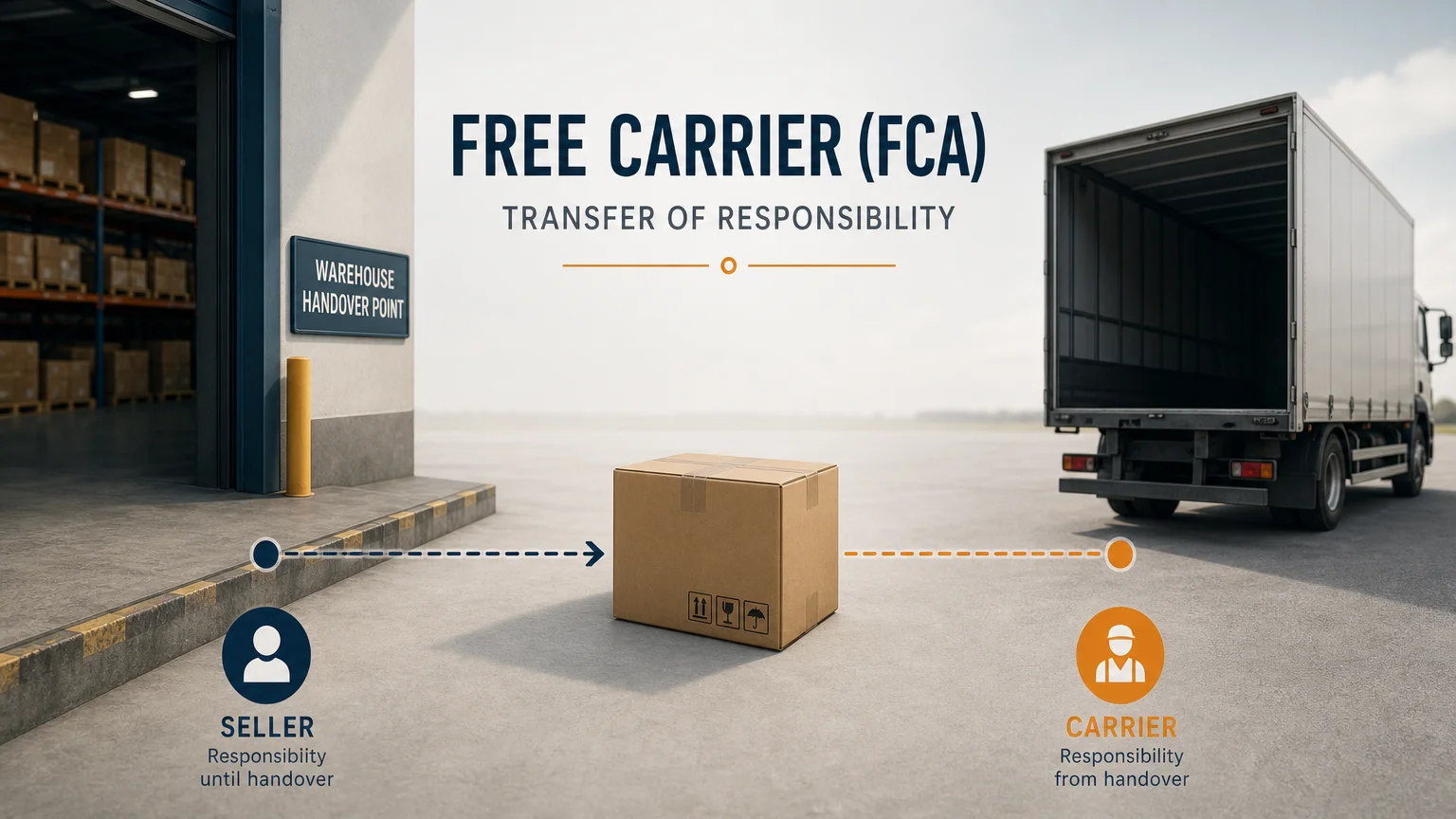
Summary: FCA means Free Carrier, an Incoterms rule that defines where the seller hands export-cleared goods to a carrier chosen by the buyer. The seller manages delivery to the named place and export clearance, while the buyer usually pays main freight, import clearance, duties, insurance, and onward delivery after risk transfers.
FCA means Free Carrier. If you are searching for the meaning of FCA terms, focus first on the named place where the seller hands the goods to the buyer-nominated carrier. For a practical explanation, you can also review our FCA meaning in shipping resource.
As of 2026, Incoterms 2020 remains the relevant framework for allocating shipping responsibilities, costs, and risks. According to a Trade.gov overview, FCA is one of the rules that can apply to any transport mode, including multimodal shipments. This makes it useful for containerized freight, air cargo, road transport, rail, and international supply chains serving US businesses.
What does FCA mean in shipping terms?
FCA stands for Free Carrier. Under this rule, the seller delivers the goods to a carrier or another party nominated by the buyer at a specifically named place. The goods must be cleared for export, and the seller remains responsible until delivery is completed at that point.
After delivery, the buyer normally assumes the risk of loss or damage. The buyer also arranges and pays for the main carriage, import procedures, duties, taxes, and onward delivery to the final destination.
FCA is flexible because it is not limited to ocean freight. The rule can support air, road, rail, sea, and multimodal transportation. The ICC checklist specifically identifies FCA as suitable for containers, multimodal transport, and delivery to an inland or port terminal.
The phrase after FCA is essential. A clause such as FCA Shenzhen is usually too vague because it does not identify the precise handover point. A clearer term would be FCA supplier warehouse, Shenzhen, China, Incoterms 2020.
Where does risk transfer under FCA?

Risk transfers when the seller has completed delivery at the agreed named place. The exact moment depends on whether delivery takes place at the seller’s premises or at another location, such as a terminal or freight forwarder warehouse.
When the named place is the seller’s warehouse or factory, the seller loads the goods onto the collecting vehicle arranged by the buyer. Delivery is completed when the goods have been loaded, so the buyer assumes risk from that point.
When the named place is another location, the seller transports the goods there on its vehicle. Delivery is normally completed when the goods are placed at that location and made available for unloading. The buyer or its carrier then handles the next stage.
This distinction affects insurance, loading arrangements, damage claims, and proof of delivery. To avoid confusion, you should define the exact handover point in the sales contract and confirm who loads or unloads the goods. Our FCA delivery definition explains these delivery scenarios in practical terms.
Who pays freight and other FCA costs?
Under FCA, the buyer usually pays the main freight. However, costs are divided according to the handover point, so both parties should review the quotation line by line.
The seller’s responsibilities
- Preparing the goods for export.
- Providing suitable export packaging, marking, and labeling.
- Completing export customs clearance.
- Providing commercial documents, such as the invoice and packing list.
- Transporting the goods to the named place when required.
- Loading the goods when the named place is the seller’s premises.
- Providing evidence that delivery to the carrier was completed.
The buyer’s responsibilities
- Nominating the carrier or freight forwarder.
- Arranging the main carriage from the named place.
- Paying freight, terminal charges, and onward transportation.
- Arranging cargo insurance if protection is required.
- Completing import customs clearance.
- Paying import duties, taxes, and applicable destination fees.
- Managing final delivery to the warehouse, distribution center, or Amazon facility.
Insurance is not automatically required under FCA. Nevertheless, the buyer should consider coverage from the moment risk transfers because the buyer controls the main journey after handover.
For sellers and buyers, FCA can provide useful cost control. The seller does not need to arrange the international freight, while the buyer can select the carrier, service level, route, and insurance arrangement.
How is FCA different from EXW, FOB, and DDP?
FCA is often compared with EXW, FOB, and DDP because each rule places responsibility at a different stage. The practical choice depends on who should control transportation and who can manage customs obligations.
FCA compared with EXW
Under EXW, the seller generally makes the goods available at its premises. The buyer takes on a larger share of the process, including export arrangements in many international transactions. This can create difficulties when the buyer is unfamiliar with the seller’s export regulations.
Under FCA, the seller handles export clearance and delivers the goods to the buyer’s nominated carrier or named place. FCA therefore gives the buyer transport control without transferring every origin responsibility to the buyer.
FCA compared with FOB
FOB is intended for sea and inland waterway transport. Risk transfers when the goods are loaded on board the vessel, while FCA can transfer risk earlier at a warehouse, terminal, or other named place.
For containerized shipments, FCA can provide a clearer handover because containers often reach a terminal before vessel loading. You should not use FOB simply because the goods will eventually travel by sea.
FCA compared with DDP
DDP places much more responsibility on the seller. The seller arranges delivery to the destination and manages import duties and taxes, subject to legal and operational feasibility in the destination country.
FCA is more suitable when the buyer wants control of international logistics. DDP may be more practical when the buyer wants one logistics partner to coordinate customs, duties, and door-to-door delivery. Our FCA Incoterms definition provides a further comparison of the rule’s responsibilities.
What documents and customs steps matter in the US?
One missing document can delay an FCA shipment after the goods leave the seller. The basic file should normally include a commercial invoice, packing list, export declaration, transport document, and any licenses or certificates required for the product.
US imports may involve duties, taxes, and user fees. The amount depends on factors such as the commodity, classification, value, and transport mode. The CBP duty guidance explains that imported goods can be subject to these charges when entering the United States.
FCA does not transfer import responsibility to the seller. The buyer must ensure that the shipment can be legally imported, that the product classification is correct, and that the required entry information is available.
Using a customs broker can simplify filing, but it does not remove the importer’s underlying responsibility. The CBP broker guidance states that the importer remains ultimately responsible for knowing applicable requirements and ensuring compliance.
For Amazon FBA shipments, you should also verify product restrictions, labeling, carton requirements, delivery appointments, and the receiving address before booking transport. FCA defines the commercial handover, but it does not replace Amazon’s inbound requirements or US import compliance.
Is FCA practical for Amazon FBA shipments?
Consider an Amazon seller buying inventory from a supplier in China. The supplier quotes FCA at its warehouse, while the seller must arrange pickup, international freight, customs, and delivery to an Amazon warehouse in the US.
This structure can work when the seller has a reliable freight forwarder and understands the responsibilities after origin handover. It also lets the seller compare air, ocean, fast boat, or rail according to urgency, shipment size, product value, and budget.
The main challenge is coordination. The seller must connect supplier pickup, export documentation, carrier booking, customs clearance, import duties, Amazon delivery requirements, and tracking. A delay at any stage can affect inventory availability and replenishment planning.
We help sellers manage these connected stages through our FCA terms of shipment guidance and freight-forwarding support. We can coordinate collection from a Chinese supplier, compare route options, manage customs under a DDP arrangement when selected, and arrange delivery to an Amazon warehouse.
FCA is often appropriate when you want control over the main carriage. If you prefer a single partner to manage the full shipment journey, a DDP service can reduce the number of separate tasks you must coordinate. The correct choice depends on your customs knowledge, shipment volume, destination, and tolerance for operational complexity.
How should you write an FCA shipping clause?
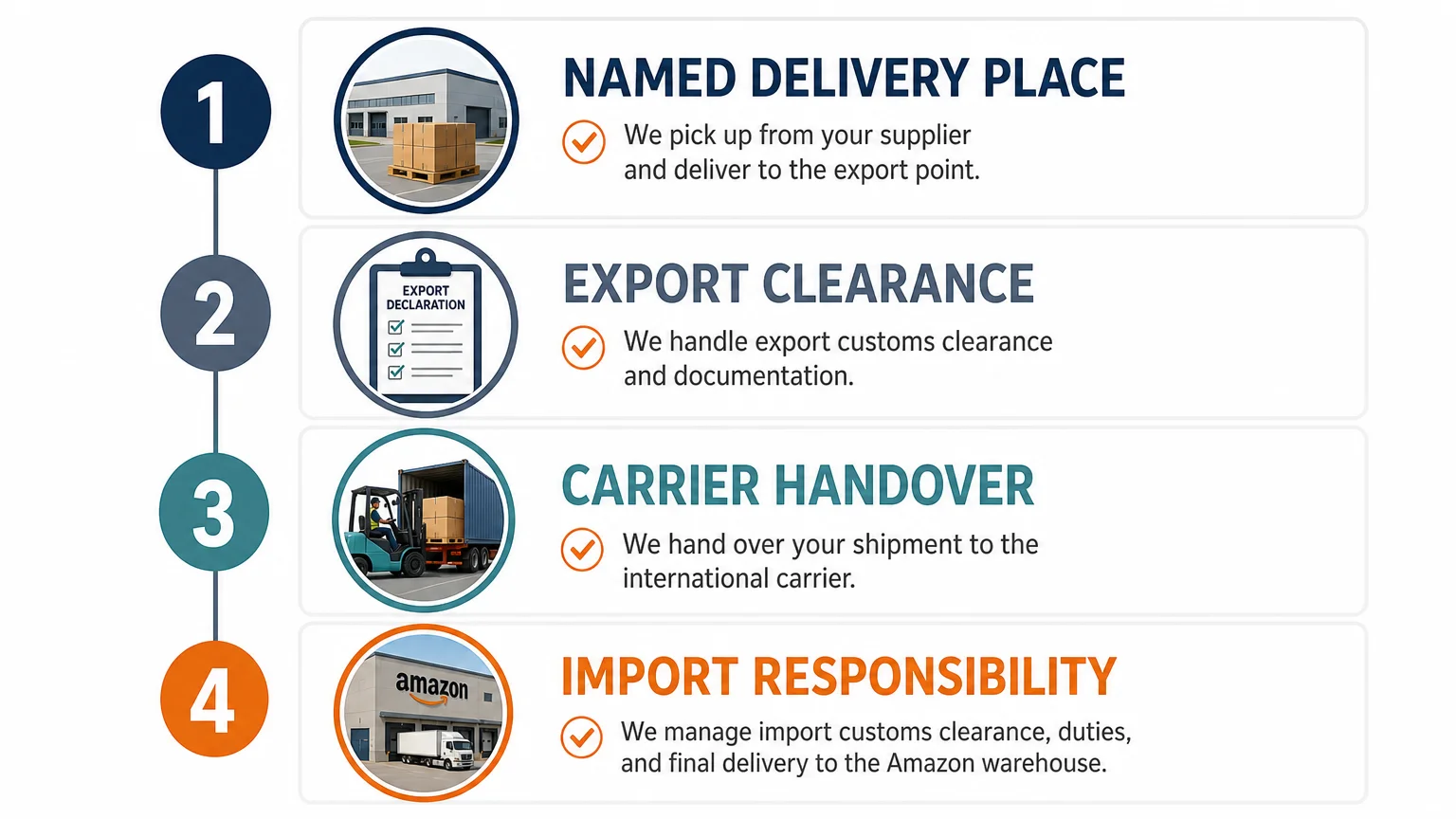
A clear FCA clause should make the handover point and cost allocation easy to verify. You can use the following checklist before accepting a quotation or purchase contract.
- Name the exact place. Include the warehouse, terminal, facility, street location, or other precise delivery point.
- State the rule and version. Use FCA followed by the named place and Incoterms 2020.
- Confirm loading duties. Specify whether the seller loads the collecting vehicle or delivers goods ready for unloading at another location.
- Identify the carrier. Confirm who nominates the carrier, who books the main carriage, and when pickup must occur.
- List documents. Agree on the invoice, packing list, export declaration, transport document, and product compliance records.
- Assign insurance. Confirm whether the buyer will insure the goods from the risk transfer point.
- Clarify destination costs. Identify who pays import clearance, duties, taxes, terminal charges, and final delivery.
FCA [exact named place], Incoterms 2020.
Do not rely on a city name alone. A precise clause reduces disputes about loading, damage, carrier delays, and the point where costs move from the seller to the buyer.
The practical meaning of FCA terms
The practical meaning of FCA terms is simple: the seller clears the goods for export and delivers them to a buyer-nominated carrier at a named place. From that handover, the buyer normally carries the risk and pays for the main transport, import clearance, duties, insurance, and final delivery. Before agreeing to FCA, confirm the exact place, loading responsibility, documents, insurance, customs roles, and destination requirements. That preparation is especially important for US imports and Amazon FBA inventory, where a commercial handover is only one part of the full delivery process.
Take action with QG Horizon
Understanding FCA is useful, but applying it to an Amazon FBA shipment requires coordination across suppliers, carriers, customs authorities, and warehouse requirements. If you are shipping inventory from China to the US, the right route depends on your urgency, budget, product characteristics, shipment volume, and preferred level of customs support.
We can coordinate supplier pickup, international freight, customs clearance, DDP duties and taxes, delivery to an Amazon warehouse, and shipment tracking. Our team can also compare fast boat, air, ocean, and rail options, then provide three route choices with estimated timelines. To discuss your shipment, explore our international shipping services and submit your product details or packing list.
Frequently Asked Questions
What does FCA stand for?
FCA stands for Free Carrier. It means the seller delivers export-cleared goods to a carrier or nominated party at a named place agreed by the buyer and seller.
Who pays freight under FCA?
The buyer normally pays the main freight after delivery at the named place. The seller pays origin costs connected with preparing the goods, export clearance, and delivery to that point.
Where does risk transfer under FCA?
Risk transfers when the seller completes delivery at the named place. If delivery occurs at the seller’s premises, this usually follows loading onto the buyer’s collecting vehicle.
Is FCA suitable for Amazon FBA shipments?
FCA can suit Amazon FBA shipments when the seller has control of freight, customs, and delivery after origin handover. At QG Horizon, we can help coordinate these stages and compare routes according to your shipment needs.
What is the difference between FCA and DDP?
Under FCA, the buyer generally manages main carriage, import clearance, duties, and onward delivery. Under DDP, the seller or its logistics provider manages a broader delivery process, including destination import costs where legally possible.
Ready to Optimize Your Amazon Shipping?
Get 3 route options tailored to your products and timeline
Get Your Quote→