How Much Can Better Freight Planning Improve Margins?

Summary: There is no universal margin lift: the result depends on freight spend as a share of sales, the savings achieved, and any offsetting inventory or service costs. As a simple illustration, cutting freight that equals 10% of revenue by 10% saves 1% of revenue, or about one percentage point of the relevant margin measure if sales and other costs stay unchanged.
How much can better freight planning improve margins? The answer is the avoidable freight expense you remove, less any costs from longer transit, extra inventory, or service disruption. For an Amazon seller, the right comparison is total landed cost and inventory availability, not the lowest quote. Our overview of freight shipping mistakes that can erode margins can help you identify common booking and planning issues before committing.
For U.S. sellers shipping from China, savings may come from choosing a suitable mode, consolidating compatible shipments, using accurate carton dimensions, and booking with realistic lead times. But a lower freight bill is not automatically a better margin if slower transit requires more inventory or contributes to a stockout. Compare freight, duties, handling, carrying costs, and service risk on the same shipment basis.
How do freight savings translate into margin points?

Start with a simple ratio: divide freight savings by revenue, then multiply by 100. The result is the approximate margin improvement in percentage points, provided sales remain steady and no other costs rise.
For example, suppose annual revenue is $100,000 and freight costs $10,000. Freight therefore equals 10% of revenue. If better planning reduces that freight bill by 10%, the business saves $1,000, equal to 1% of revenue. That is approximately a one percentage point improvement in the relevant margin measure, before any offsetting costs.
Use the margin measure that matches your accounting. If inbound freight is included in cost of goods sold, the savings may improve gross margin; if it is recorded as an operating expense, it may improve operating margin. A 2019 road-freight cost study found that costs vary with mileage and identified fuel, labor, and tolls among major carrier expenses. It is carrier-side research, not a seller-specific forecast, but it reinforces the value of understanding the cost components behind a freight quote.
Do not confuse a percentage reduction in freight with a percentage increase in profit. If freight is a small share of your revenue, even a meaningful freight reduction may add only a modest number of margin points. The actual result depends on your own spend, sales, and any operational changes needed to achieve the saving.
Which planning decisions reduce cost per unit?
Imagine two shipments of the same product, one sent in partially filled cartons and another packed to use the available space efficiently. Their product value may be identical, but their freight cost per sellable unit can differ. That is why planning should examine shipment dimensions and total quoted charges, not just the headline price per kilogram.
First, confirm the packing list has accurate carton quantities, weights, and dimensions. Incorrect measurements can make quotes hard to compare and may lead to unexpected charges. Next, check whether compatible inventory can be consolidated without creating a delay that disrupts replenishment. Compare the full quoted amount, including pickup, freight, customs, duties, taxes, and destination delivery where applicable.
For more practical ideas, see our ways to reduce Amazon FBA freight costs. The aim is not to choose the cheapest option in isolation. It is to find a lower landed freight cost while keeping the delivery plan suitable for your inventory needs.
When can lower freight spend create higher total cost?
A shipment that arrives too late can erase apparent freight savings if you respond with a last-minute premium shipment, carry extra inventory, or miss sales. Conversely, shipping too early can tie up cash in goods that are not yet needed. Better planning weighs inventory carrying cost and stockout risk alongside transportation charges.
CLA’s guidance published in 2022 for 2023 planning emphasized realistic lead times, noting that expedited or last-minute freight can carry a premium. Treat it as dated planning guidance, not a current rate benchmark. For your own operation, compare the estimated transit time and cost of each available route against the date inventory is needed, then account for the cost of holding a reasonable buffer.
That trade-off matters for Amazon sellers balancing regular replenishment with urgent restocking. Our article on how to reduce shipping costs without increasing stockouts explores how to consider freight savings alongside inventory availability. A slower option only helps if the timing still supports your sales plan.
Which measures reveal whether the plan worked?
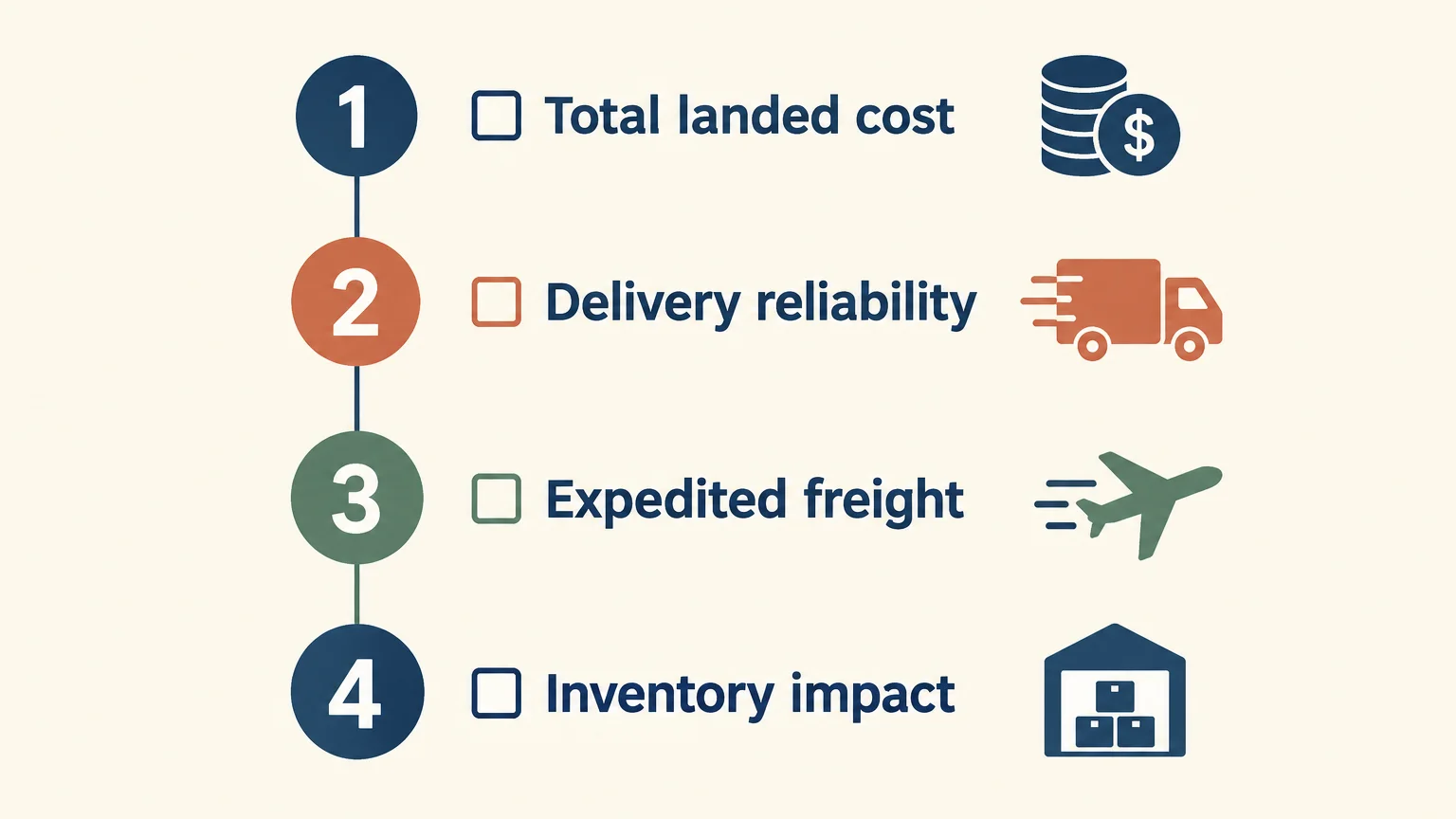
Before changing a route or consolidating orders, record a baseline. Then compare shipments with similar products, dimensions, quantities, and destinations so that a change in freight cost is not confused with a change in shipment profile.
- Freight cost per unit: Track freight against sellable units, not just the total invoice.
- Freight as a share of revenue: Review the ratio over a consistent period.
- Delivery reliability: Compare estimated timing with actual arrival and receiving plans.
- Expedited freight: Record emergency shipments that offset planned savings.
- Inventory impact: Monitor extra holding costs and stockout exposure alongside freight spend.
A 2025 Grant Thornton analysis of transportation companies identifies inefficient route planning and unused capacity as sources of inefficiency. It also connects route and load planning with fuel efficiency, reliability, and vehicle utilization. That is carrier-focused analysis, but the practical lesson for shippers is relevant: measure service outcomes as well as cost, rather than treating the lowest quote as the only success metric.
How can US FBA sellers compare China shipping routes?
For China-to-US Amazon shipments, route planning begins with the shipment’s urgency, weight, volume, destination, and inventory plan. Air is positioned for urgent or lightweight shipments, fast boat for regular cartons where sellers are balancing speed and cost, and ocean for large-volume or non-urgent freight. These are route-selection considerations, not universal delivery guarantees.
Our team began as Amazon sellers and has shipped from China for more than five years. We provide three route options with shipment-specific pricing and estimated timelines, so you can compare the trade-offs against your budget and replenishment date. Our route playbook draws on dozens of tested routes, and we claim average savings of 10% to 20% per shipment. That is a first-party claim, not independently verified or guaranteed; your result depends on the shipment and route.
When you compare quotes, check whether they cover the same shipment details and destination services. Our guide to optimize Amazon FBA shipping costs can help you review route and cost factors before selecting an option. A quote based on your packing details makes it easier to assess the real trade-off between timing and cost per unit.
Plan for net margin improvement
Better freight planning can improve margins by reducing avoidable shipping costs, but there is no reliable universal percentage. Estimate the effect by dividing expected freight savings by revenue, then adjust for inventory, service, and other costs that may change. Track comparable shipments over time, and retain a route only when the savings hold without weakening delivery performance.
Compare Routes for Your FBA Inventory
If you ship from China to Amazon warehouses, comparing route options against your timing and shipment details can help you make a more informed freight decision. The useful comparison is the quoted cost alongside the estimated timeline and customs handling, not a rate viewed on its own.
We coordinate supplier pickup, international freight, destination customs clearance, DDP duties and taxes, door-to-door delivery, and tracking. Share your product and packing details to receive three route options with shipment-specific pricing and estimated timelines within 24 hours. Our DDP quotes include destination customs clearance and duties and taxes. Standard Chinese export declaration is included; an additional fee applies when the declaration uses the supplier’s name for a Chinese export tax refund. Review our freight forwarding services to discuss your shipment.
Frequently Asked Questions
Is there a standard margin improvement from better freight planning?
No single percentage applies to every seller because freight spend, shipment size, route, and sales vary. Estimate the effect using your own freight savings as a share of revenue, then account for any costs that change.
How do I calculate the margin effect of freight savings?
Divide the freight savings by revenue and multiply by 100 to estimate the improvement in percentage points. Use the margin measure that matches how your business records freight costs.
Can a cheaper shipping route reduce profit?
Yes, if the slower route leads to more inventory expense, emergency shipping, or a stockout. Compare the full cost and delivery plan rather than the quoted freight charge alone.
Which freight costs should I compare between quotes?
Compare quotes for the same shipment details and destination, including applicable pickup, freight, customs, duties, taxes, and delivery charges. Check the estimated timeline and service terms as well as the total price.
How can QG Horizon help compare China-to-Amazon shipments?
Our Amazon FBA freight-forwarding service coordinates shipping from a Chinese supplier to an Amazon warehouse and provides route options with shipment-specific pricing and estimated timelines. You can compare options against your budget, urgency, shipment size, and destination.
Ready to Optimize Your Amazon Shipping?
Get 3 route options tailored to your products and timeline
Get Your Quote→