Is One Shipping Partner Worth It for FBA Sellers in 2026?
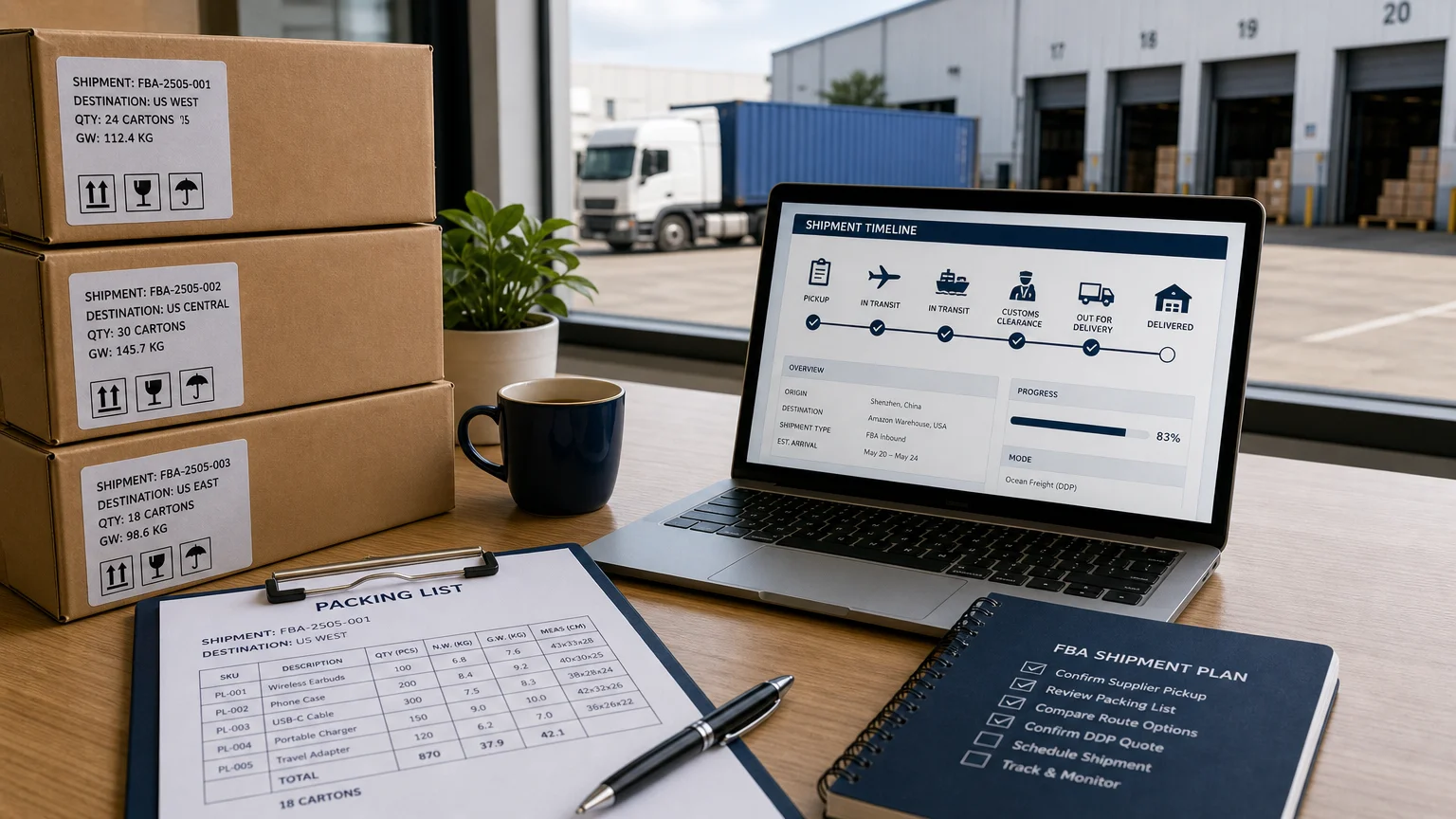
Summary: Usually, one shipping partner is worth it when your inventory moves from China to Amazon regularly, involves customs, or requires several freight modes. A reliable partner can reduce handoffs, clarify landed costs, coordinate DDP delivery, and improve shipment visibility. However, you should still compare quotes, test performance, and keep a backup plan for urgent or specialized freight.
One missed delivery appointment, customs hold, or labeling error can cost more than the savings from a low freight quote. If you are asking, is one shipping partner worth it for FBA sellers?, the practical answer is yes when that partner manages the entire inbound workflow rather than simply selling transportation.
Amazon’s US help materials list a 3.5% fuel and logistics related surcharge on FBA fulfillment fees beginning April 17, 2026, which makes cost visibility even more important. The right partner should help you model the full shipment cost, select a suitable route, and protect inventory availability without removing your control.
When does one shipping partner make sense?
One shipping partner usually makes sense when your logistics process contains several connected stages. These may include supplier pickup, export documentation, international freight, customs clearance, duties, final delivery, and Amazon receiving requirements. Managing each stage separately can work for an experienced logistics team, but it creates more handoffs and more opportunities for inconsistent information.
The strongest case appears when you ship from China to Amazon warehouses on a recurring basis. A single partner can maintain your supplier details, product information, carton data, route preferences, and delivery expectations across shipments. That continuity is valuable when you manage regular replenishment, product launches, or multiple SKUs.
One partner can also simplify accountability. If the supplier, carrier, customs broker, and final-mile provider are separate, it may be difficult to determine where a delay began. With one coordinated provider, you have a clear point of contact for exceptions, document corrections, tracking updates, and delivery questions.
That does not mean every seller should use one provider for every shipment. A small, low-risk parcel may be simple enough to manage independently. A specialized product may also require a broker, inspection company, or prep provider with capabilities that a general freight forwarder does not offer.
What does a single FBA shipping partner actually coordinate?
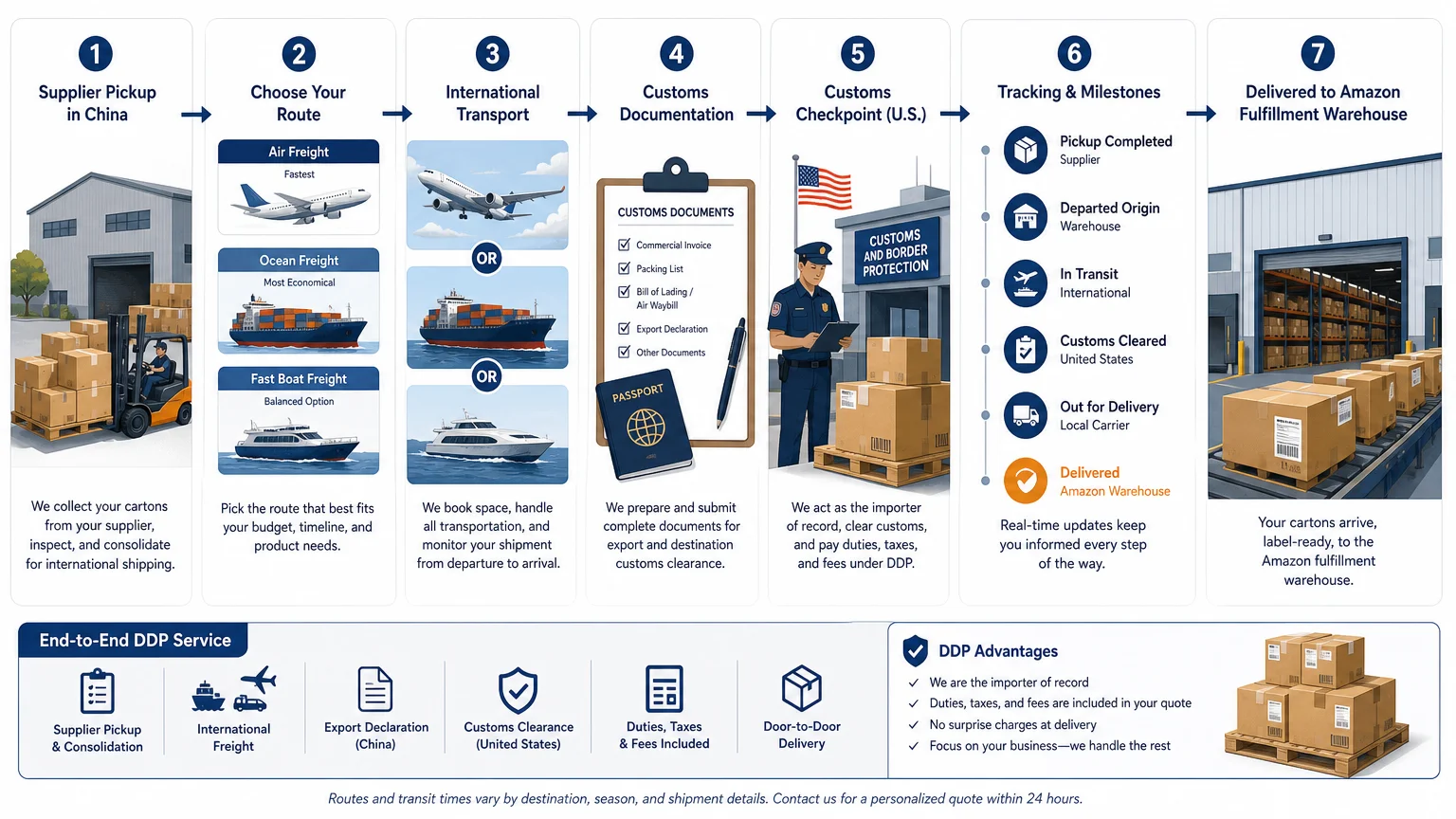
A shipping partner is valuable when the service scope matches the full journey of your inventory. For example, our China-based, Shenzhen-operated logistics team coordinates supplier pickup, Chinese export declarations, international air, fast-boat, ocean, or rail freight, destination customs clearance, DDP duties and taxes, door-to-door delivery, and tracking.
This structure gives you more than a freight booking. It creates one operating process for decisions that affect both cash flow and inventory availability. You can compare speed, cost, product characteristics, shipment size, destination, and urgency before selecting a route.
- Air freight is positioned for urgent restocking, launches, and lightweight or high-value products.
- Fast boat freight is suited to regular e-commerce cartons that need a balance between cost and speed.
- Ocean freight is generally more suitable for planned, high-volume, pallet, and non-urgent shipments.
- Rail freight supports selected China to Europe flows where delivery timing and freight cost must be balanced.
Our service provides three route options with pricing and estimated timelines within 24 hours after receiving shipment information. Sellers can then select an option based on budget and urgency instead of accepting one unexplained method.
To understand the wider evaluation process, you can use our freight forwarder selection guide. The important point is to assess the complete workflow, not only the transportation leg.
Can one partner reduce your true landed cost?
The lowest base freight rate is not always the lowest total cost. Your actual landed cost may include supplier pickup, export handling, freight, customs clearance, duties, taxes, destination handling, final delivery, insurance, and charges caused by missing or incorrect information.
A single partner can reduce avoidable costs by keeping these elements in one quote and one process. It can also make comparisons more accurate because you are less likely to compare an all-inclusive price with a freight-only price.
Ask each provider to clarify the following points in writing:
- Whether supplier pickup is included.
- Which export declaration services are included.
- Whether customs clearance, duties, and taxes are included.
- Who acts as importer of record at destination.
- Whether delivery to the assigned Amazon warehouse is included.
- How insurance, storage, inspections, and unexpected handling are charged.
- Which fees could change after the quote is accepted.
Our DDP quotes package destination customs clearance, duties, and taxes into an all-inclusive shipment price. The standard Chinese export declaration is included. An additional fee applies when the declaration is made under the supplier’s name for a Chinese export tax refund.
DDP should still be reviewed carefully. Confirm the importer-of-record arrangement, product eligibility, customs responsibilities, and documentation process. Detailed eligibility rules and a restricted-product list are not supplied in every quote, so you should request confirmation for your specific product before shipping.
When is one partner not the best arrangement?
Consolidation creates efficiency, but it can also create concentration risk. If one provider handles every lane, mode, and shipment, a service failure may affect your entire replenishment schedule. This is especially important for sellers with seasonal demand, high-value inventory, or narrow stockout margins.
A split-provider approach may be sensible in several situations:
- You have a dedicated internal logistics specialist who can coordinate multiple providers.
- Your products require specialist compliance, inspection, or preparation services.
- You ship from several countries and need local expertise in each origin market.
- You want separate providers for standard replenishment and emergency restocking.
- You need independent customs, insurance, or audit support.
The answer is often a primary partner plus a tested backup, rather than one provider with no alternative. Use the primary partner for routine shipments and build a secondary relationship before an emergency occurs.
You should also separate logistics consolidation from decision-making dependence. A good provider should explain route options and tradeoffs. It should not prevent you from comparing air, ocean, fast boat, rail, or Amazon-managed freight when those alternatives are relevant.
For sellers evaluating Amazon-managed logistics alongside independent options, our resource explains how to compare Amazon Global Logistics with other freight options. The goal is not to select one method permanently. It is to compare the total cost, responsibilities, and risk for each shipment.
How should you vet one shipping partner?
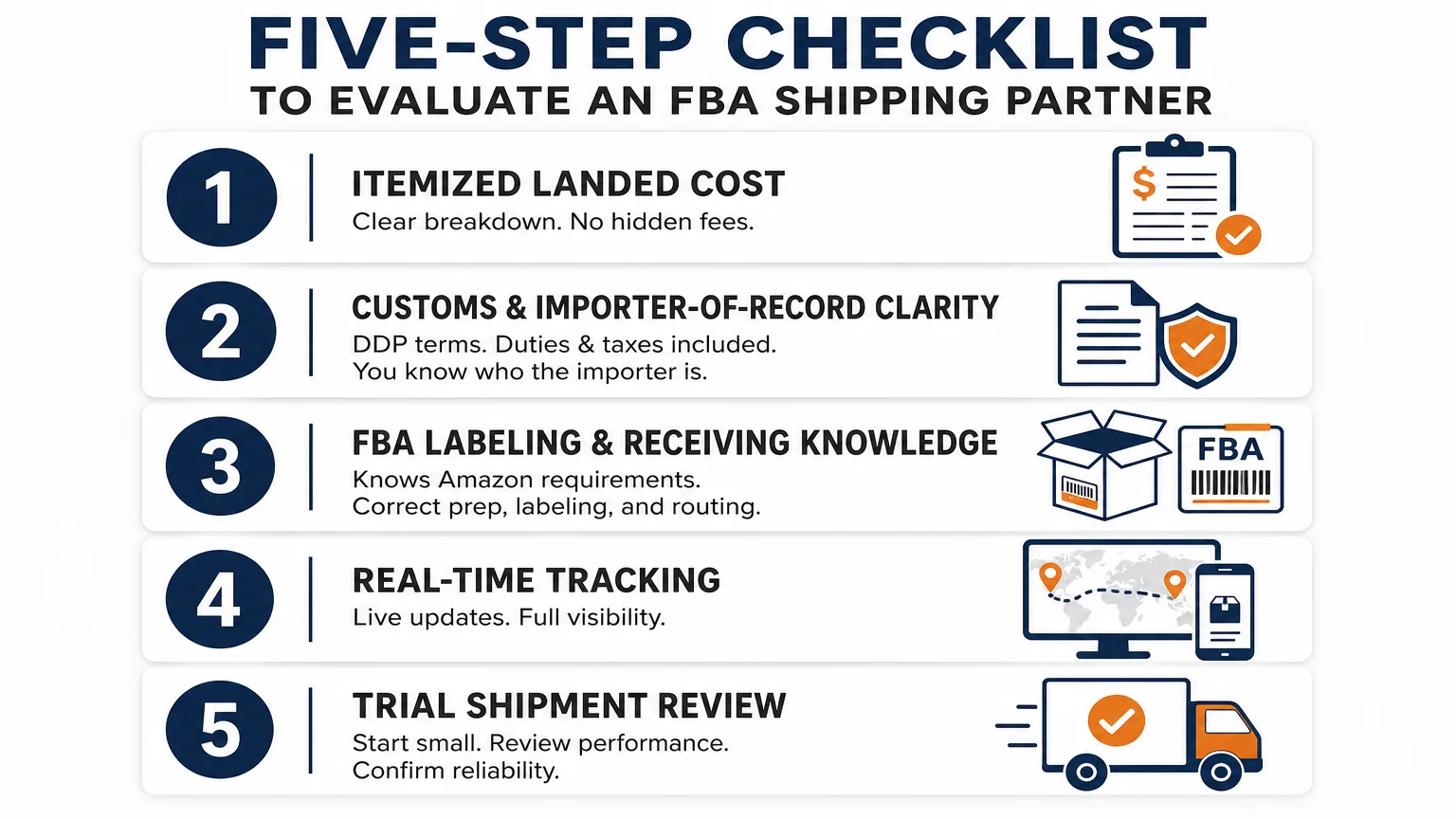
Start with the process, not the sales presentation. A trustworthy partner should explain how it handles supplier coordination, documents, customs, FBA labels, delivery appointments, tracking, and exceptions.
Request an itemized quote for the same shipment from at least three providers. Give each provider identical information, including product category, supplier location, carton count, dimensions, gross weight, destination, target delivery date, and preferred Incoterm.
Then compare the responses against these practical criteria:
- FBA experience: Can the provider explain carton labeling, shipment plans, receiving requirements, and common rejection risks?
- Cost transparency: Does the quote separate included services from possible surcharges?
- Customs clarity: Does the provider explain classification, duties, taxes, and importer-of-record responsibilities?
- Communication: Will you receive milestone updates and prompt exception notices?
- Route flexibility: Can the provider recommend different modes for urgent, regular, and high-volume shipments?
- Problem handling: Can the provider describe what happens after a customs hold, document error, or delivery delay?
For US-bound shipments, consult CBP import guidance alongside your provider’s explanation. This helps you understand which questions to ask about entry documentation and customs responsibilities.
You can also ask for a trial shipment before moving all inventory. Measure quote accuracy, document accuracy, milestone communication, delivery performance, and the speed of issue resolution. A trial will not remove every risk, but it can reveal whether the provider’s process works under real operating conditions.
Our approach combines FBA-specific experience with route comparison, DDP handling, tracking, and WhatsApp support. When you need to assess the final-mile provider as well, our article on choosing the right carrier for Amazon FBA shipments can help you evaluate that part of the workflow.
What should your shipment information include?
A partner cannot produce a reliable quote from a product name alone. Accurate shipment information improves both pricing and route recommendations.
Prepare the product description, quantity, unit weight, carton count, carton dimensions, supplier address, destination warehouse, product materials, and target delivery date. Include any known labeling, packaging, battery, liquid, or compliance considerations.
A complete packing list is particularly useful because it lets the provider assess weight, volume, route suitability, and likely handling requirements. Our intake process accepts PNG, JPG, WEBP, PDF, and XLSX files up to 10 MB. The uploaded file can contain product details, quantities, weights, and dimensions.
For duty planning, use the official HTS database as a reference for product classification. You should still confirm the classification with a qualified customs professional when the product is complex or regulated.
Do not treat the first quote as a fixed promise if the underlying shipment details are incomplete. A meaningful comparison requires the same product data, Incoterm, destination, customs scope, delivery scope, and insurance assumptions across every provider.
How can one partner support inventory risk?
Shipping speed matters because inventory is tied to sales velocity. Ocean freight may support planned replenishment, while air freight may be justified when a stockout would damage revenue, ranking, or a product launch.
The best partner does not simply book the fastest available option. It helps you match the route to your inventory position. That means considering current stock, daily sales, production timing, cash flow, product value, and the cost of being out of stock.
A practical operating model may use one partner for several route types. For example, you might use ocean freight for planned bulk inventory, fast boat for recurring cartons, and air freight for a limited emergency quantity. This preserves coordination while avoiding a one-mode strategy.
Tracking is also part of inventory risk management. Our service provides real-time tracking, WhatsApp updates, and key-stage notifications. WhatsApp support is available seven days per week, with responses described as occurring within hours. These are stated service commitments, so you should confirm the exact communication process for your shipment.
Ask whether the provider will notify you when the cargo is collected, exported, loaded, cleared, transferred, and delivered. You should also know who contacts you when the estimated timeline changes.
What is the most practical setup for FBA sellers?
For many sellers, the most practical structure is one primary FBA shipping partner, one documented backup option, and a shipment-level review before every booking.
Your primary partner should handle routine coordination and retain your shipment history. Your backup should be capable of supporting at least one important lane or mode. Before booking, compare the current quote against your previous landed cost, inventory urgency, and available alternatives.
Review these metrics after every shipment:
- Total cost per delivered unit.
- Quoted timeline compared with actual milestones.
- Customs and documentation accuracy.
- Amazon receiving issues or label discrepancies.
- Response time when an exception occurs.
- Unexpected charges and their explanations.
This system gives you the convenience of consolidation without surrendering oversight. It also makes it easier to replace a provider if communication, transparency, or execution declines.
Is one shipping partner worth it for FBA sellers?
One shipping partner is usually worth it for FBA sellers when the provider coordinates freight, customs, DDP responsibilities, delivery, tracking, and route selection in one accountable process. The arrangement is less valuable when the shipment is simple, the product requires specialist handling, or your team already has strong logistics capabilities. Choose based on total landed cost, operational visibility, FBA knowledge, and tested performance, then keep a backup route for resilience.
Build a More Predictable FBA Shipping Process
When supplier coordination, freight selection, customs, and Amazon delivery become difficult to manage separately, a coordinated logistics process can reduce administrative work and improve visibility.
We coordinate China-to-Amazon FBA shipments across air, fast boat, ocean, and rail routes. You can submit your shipment details or packing list, receive three route options with estimated timelines, and select the option that fits your budget and urgency. Explore our Amazon FBA shipping services to discuss your next shipment.
Frequently Asked Questions
Is it cheaper to use one FBA shipping partner?
It can be cheaper when one provider combines supplier pickup, freight, customs, duties, and delivery into a transparent quote. However, compare total landed cost rather than the first freight rate.
Can one partner handle different shipping modes?
Some providers support air, ocean, fast boat, and rail routes. Confirm that the partner can explain when each mode fits your shipment size, urgency, destination, and inventory position.
Should I use DDP for Amazon FBA shipments?
DDP can simplify customs administration by packaging duties and taxes into the quoted shipment price. Confirm who acts as importer of record, which services are included, and whether your product is eligible for the proposed arrangement.
How should I test a new shipping partner?
Start with a manageable trial shipment and review quote accuracy, documentation, milestone updates, delivery performance, Amazon receiving results, and exception handling. Keep a written record so you can compare the provider with alternatives.
What does QG Horizon include in its FBA shipping service?
Our Amazon FBA freight forwarding service coordinates supplier pickup, international freight, Chinese export declaration, destination customs clearance, DDP duties and taxes, door-to-door delivery, tracking, and shipment support. Route options include air, fast boat, ocean, and rail, depending on the shipment and destination.
Ready to Optimize Your Amazon Shipping?
Get 3 route options tailored to your products and timeline
Get Your Quote→