Mainland China to US Shipping: Costs, Timing, and FBA
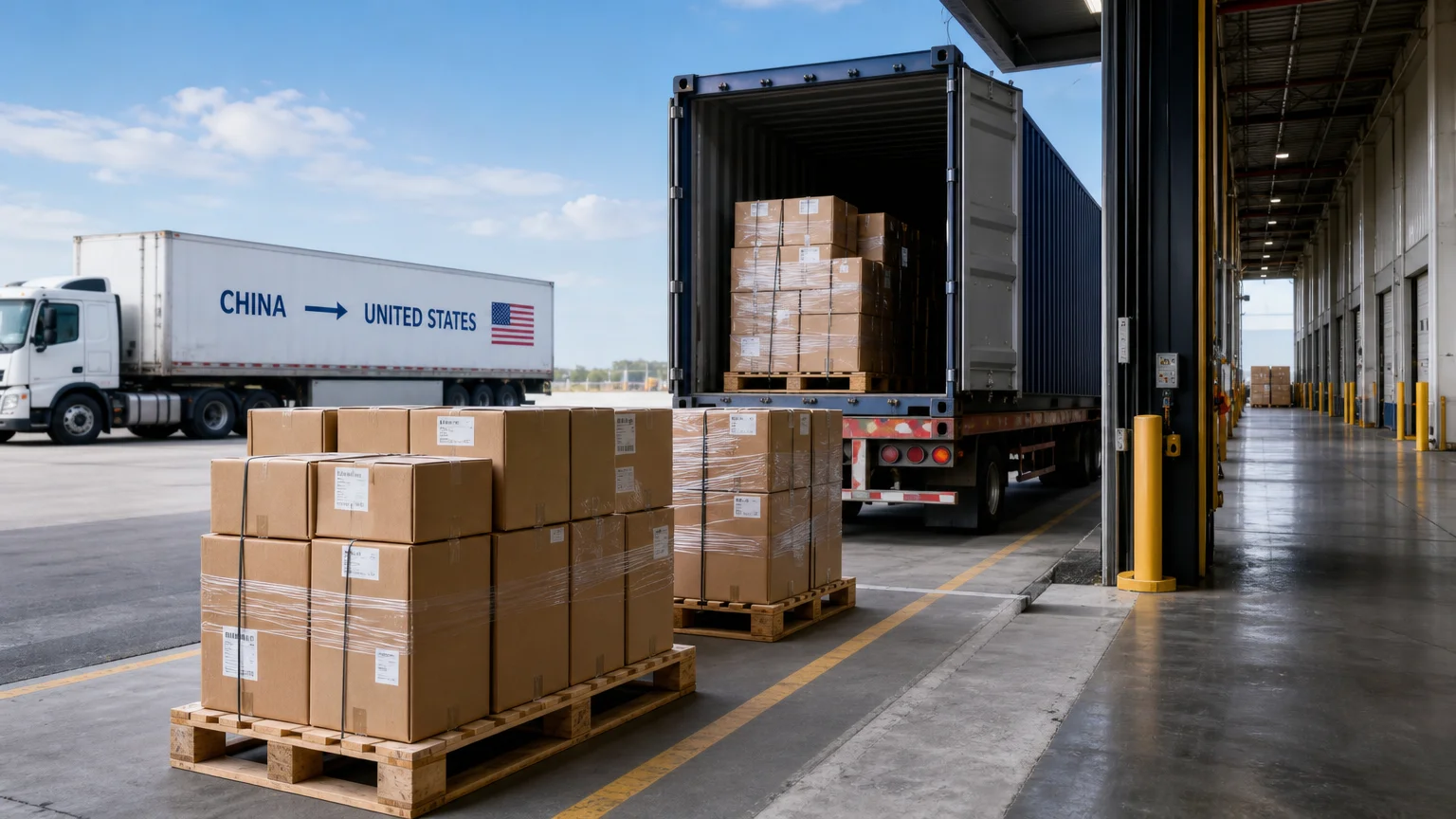
Summary: Shipping goods from mainland China to the United States requires a decision about freight mode, shipment size, delivery urgency, customs responsibility, and final destination. Express, air, fast boat, ocean, and DDP services each suit different inventory profiles. For Amazon FBA sellers, accurate documents, suitable packaging, shipment visibility, and a reliable delivery plan are as important as the freight rate.
When inventory must move from a Chinese supplier to a US warehouse, the cheapest freight option is not always the most economical choice. Your decision affects stock availability, cash flow, customs exposure, and the risk of missed Amazon receiving windows. To estimate China-to-US Amazon FBA shipping costs, you need to evaluate the complete shipment rather than compare one base rate.
The phrase shipping from mainland China to the US covers several different logistics models. A small sample may move by express courier, while commercial cartons may suit air freight, fast boat, or ocean shipping. Amazon also provides logistics programs for sellers shipping inventory from China, including options connected to its US fulfillment network. Amazon’s China selling guidance confirms that sellers can use services such as Amazon Global Logistics, Amazon SEND, and partner carriers for US inventory movements.
What does mainland China to US shipping include?
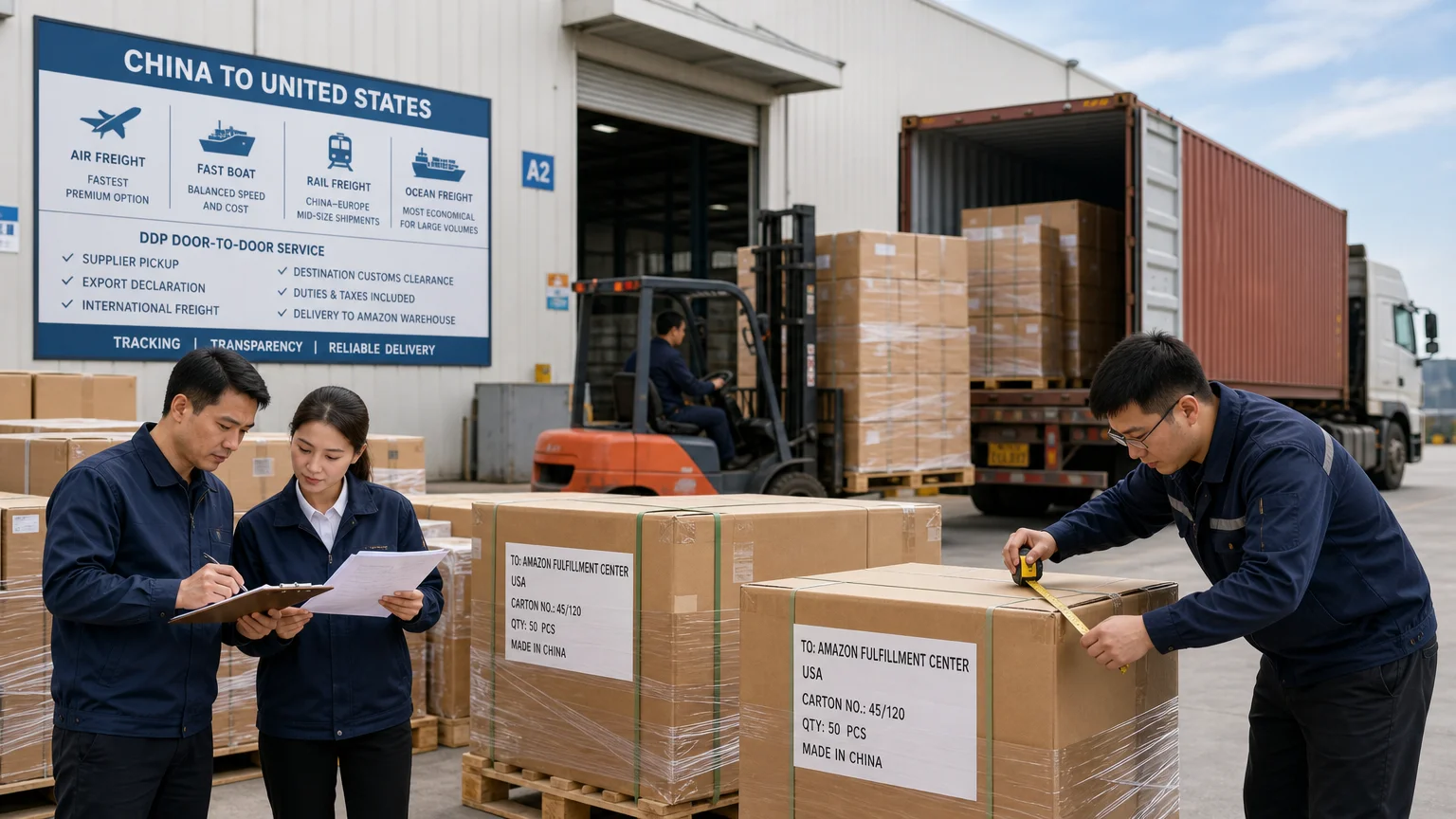
A China to US shipment is more than the international movement between two points. It normally involves supplier pickup, export handling in China, freight transportation, arrival processing, customs clearance, possible duties and taxes, domestic delivery, and receiving at the final warehouse. For FBA inventory, the process may also involve shipment planning, carton information, labeling, appointment coordination, and delivery to the Amazon location assigned in Seller Central.
The first distinction is between port-to-port shipping and door-to-door shipping. Port-to-port service ends when cargo reaches the destination port or airport. You must then arrange customs clearance, inland transportation, and delivery to your warehouse or Amazon destination. Door-to-door service coordinates more stages, which can simplify administration and make the total cost easier to evaluate.
The second distinction is between freight cost and landed cost. Freight cost covers the main transportation service. Landed cost may also include pickup, export documentation, terminal handling, customs brokerage, duties, taxes, insurance, domestic trucking, storage, and delivery charges. A low ocean rate can become less attractive if the quote excludes several destination costs.
For sellers who want one coordinated process, we manage supplier collection, international freight, customs handling, DDP duties and taxes, door-to-door delivery, tracking, and shipment support. Our team operates from Shenzhen and focuses on inventory moving from Chinese suppliers to Amazon warehouses and other commercial destinations.
Which shipping method fits your cargo?
The right mode depends on four practical questions: How quickly must the goods arrive? How much space do they occupy? What is their value and product type? How much customs and delivery work do you want to manage yourself?
| Shipping method | Best suited to | Cost and timing logic | Main trade-off |
|---|---|---|---|
| Express courier | Samples, documents, and very small urgent parcels | Fastest handling, with a premium price per kilogram | Usually unsuitable for regular commercial inventory or bulky cartons |
| Air freight | Urgent replenishment, launches, lightweight goods, and high-value products | Faster than ocean freight, with charges influenced by actual and dimensional weight | Higher transport cost and more product restrictions than ocean shipping |
| Fast boat | Recurring e-commerce cartons and shipments requiring a speed and cost balance | Intermediate route positioned between air and standard ocean freight | Slower than air and less suitable for extremely urgent stock |
| Ocean freight | Large volumes, pallets, planned replenishment, and non-urgent inventory | Usually the most economical option for high-volume cargo | Longer transit and greater exposure to port, weather, and customs delays |
| DDP door-to-door | Sellers who want customs, duties, and final delivery coordinated by one provider | Combines a selected freight mode with an all-inclusive quoted structure | Exact pricing depends on the product, route, shipment data, and applicable handling |
QG Horizon positions air freight as the fastest and most premium route. Fast boat is intended as a regular-shipment compromise, while ocean freight is designed for larger and less urgent cargo. The company also provides rail services for selected China to Europe flows, rather than presenting rail as a standard direct solution for mainland China to US shipping.
For a practical comparison of air, ocean, fast boat, and rail, read our Amazon FBA shipping options from China article. The important point is to match the mode to the shipment, not to choose the same route for every purchase order.
How should you estimate the total shipping cost?
There is no single mainland China to US shipping price that applies to every shipment. A forwarder normally calculates the quote from the cargo’s weight, volume, chargeable weight, origin, destination, product category, selected mode, customs requirements, and final delivery point.
Air cargo can be priced using dimensional weight when cartons occupy substantial space relative to their physical weight. Ocean LCL is generally influenced by cubic volume and handling requirements. FCL is normally quoted by container, which means an underfilled container can increase the effective cost per unit. Express services tend to use higher per-kilogram pricing because they include fast handling and broad door-to-door coverage.
Your quote should identify whether it includes supplier pickup, export declaration, origin handling, main freight, destination customs clearance, duties, taxes, terminal charges, domestic delivery, and insurance. It should also state whether the price is port-to-port, airport-to-door, or fully door-to-door.
US import charges can form part of the landed cost even when the freight rate appears attractive. In a February 13, 2026 knowledge article, U.S. Customs and Border Protection fee guidance listed a 0.3464 percent Merchandise Processing Fee for formal entries, with published minimum and maximum amounts, and a 0.125 percent Harbor Maintenance Fee for qualifying ocean cargo. These figures are separate from product duties, brokerage, transportation, and other charges, and import rules can change.
Our quote model is shipment-specific. When you submit product information, we provide three route options with estimated timelines and pricing within 24 hours. This allows you to compare budget, urgency, and service scope before selecting a route.
What customs documents are required for US imports?
Commercial shipments from mainland China generally require accurate trade documentation. The core file commonly includes a commercial invoice, packing list, and bill of lading for ocean freight or airway bill for air freight. Depending on the product, you may also need certificates, permits, testing records, or documents required by another US government agency.
The commercial invoice should describe the goods clearly, state the transaction value, identify the parties, and support the correct tariff classification. The packing list should align with the physical shipment and identify carton quantities, weights, dimensions, and product details. Inconsistent descriptions or values can create questions during customs review.
Product eligibility must be checked before the goods leave China. Some categories may have special requirements, including food, cosmetics, batteries, electronics, textiles, chemicals, medical products, and goods containing regulated materials. Detailed eligibility rules and a complete restricted-product list are not supplied in our service information, so you should confirm product-specific requirements before booking.
DDP can reduce the number of customs tasks handled directly by the seller. Under our stated DDP structure, we coordinate destination customs clearance, duties and taxes, and delivery to the Amazon warehouse or other agreed destination. The quote is presented as all-inclusive, subject to the stated exception for an additional fee when the export declaration is made under the supplier’s name for a Chinese export tax refund.
DDP does not remove the need for accurate product information. The importer or designated logistics party still needs correct descriptions, values, quantities, and shipment details. Misdeclared goods can create compliance and delivery problems regardless of the freight mode selected.
How does Amazon FBA change the shipping decision?
Amazon FBA adds operational requirements beyond ordinary warehouse delivery. Your shipment must arrive at the destination assigned through the Amazon workflow, with the inventory and carton information matching the relevant shipping plan. Late delivery, incorrect labels, or incomplete information can affect receiving and stock availability.
Amazon’s official logistics information describes direct shipment options from China to Amazon fulfillment and warehousing facilities in the United States. It also distinguishes ocean and air services, including standard ocean, faster ocean, and air freight options. This confirms that FBA sellers should evaluate both transport speed and the way inventory enters the Amazon network.
For a seller, the most useful comparison is often between the cost of faster replenishment and the cost of running out of stock. Air freight may protect a product launch or urgent restock. Ocean freight may protect margins for planned volume. Fast boat can be appropriate when standard ocean is too slow but air is difficult to justify.
Before shipping, confirm the following information:
- Supplier pickup address and cargo readiness date
- Product names, quantities, weights, dimensions, and carton counts
- Amazon shipment destination and labeling requirements
- Commercial invoice and packing list details
- Product restrictions, batteries, liquids, or other sensitive characteristics
- Required delivery timing and acceptable delay buffer
Our how to ship from China to Amazon FBA resource explains the planning process in more detail. For regular inventory, a reliable replenishment rhythm is usually more valuable than selecting the lowest rate for one shipment.
Why do origin and destination locations matter?
Shenzhen, Shanghai, Ningbo, Guangzhou, and other Chinese logistics hubs do not provide identical routing conditions. Your supplier’s distance from the export gateway can affect pickup charges, cutoff times, and the number of domestic handoffs before international departure.
The US destination matters just as much. A shipment entering through a West Coast gateway may require additional domestic transportation for an East Coast warehouse. Conversely, an East Coast or Gulf Coast arrival may offer a more direct inland connection for certain destinations, even if the international leg takes longer.
Arrival port performance can also influence the final delivery window. The US Department of Transportation’s 2026 port performance report provides national port data and reinforces why port operations should be considered when planning a shipment, rather than treating vessel transit as the complete delivery timeline.
For Amazon FBA, the relevant destination is not simply Los Angeles, New York, or another port. The shipment must reach the Amazon facility assigned to your inventory. That means inland trucking, appointment planning, delivery instructions, and receiving time can materially affect the real lead time.
We use supplier location, shipment scale, destination, product characteristics, urgency, and customs requirements when comparing routes. Our Shenzhen operation is positioned near factories and ports, which helps us coordinate collection and export preparation before the international freight stage.
What should you look for in a freight forwarder?
A freight forwarder should make the shipment easier to control, not merely provide a low headline rate. Before selecting a provider, ask whether the quote identifies the complete scope, whether customs responsibility is clear, whether tracking is available, and whether the team understands Amazon receiving requirements.
QG Horizon began from an Amazon private-label selling operation. Our team states that it has shipped from China for more than five years, tested dozens of routes, worked with vetted carriers, and used personally tested logistics processes. These are first-party experience statements, not independent certification, but they are directly relevant to sellers moving inventory into Amazon warehouses.
Our route comparison process provides three options according to the seller’s budget and urgency. Shipment progress is communicated through real-time tracking, WhatsApp updates, and key-stage notifications. WhatsApp support is available seven days per week, with responses described as occurring within hours.
The company also claims average savings of 10 to 20 percent per shipment through tested routes. This is a first-party, unverified claim, so it should be treated as a potential route-selection benefit rather than a guaranteed result. The appropriate comparison remains the final all-in quote for your specific shipment.
To understand the wider process, consult our China-to-Amazon FBA shipping guide. It is useful when you are comparing supplier pickup, freight, customs, delivery, tracking, and Amazon receiving as one connected workflow.
What is the practical process from quote to delivery?
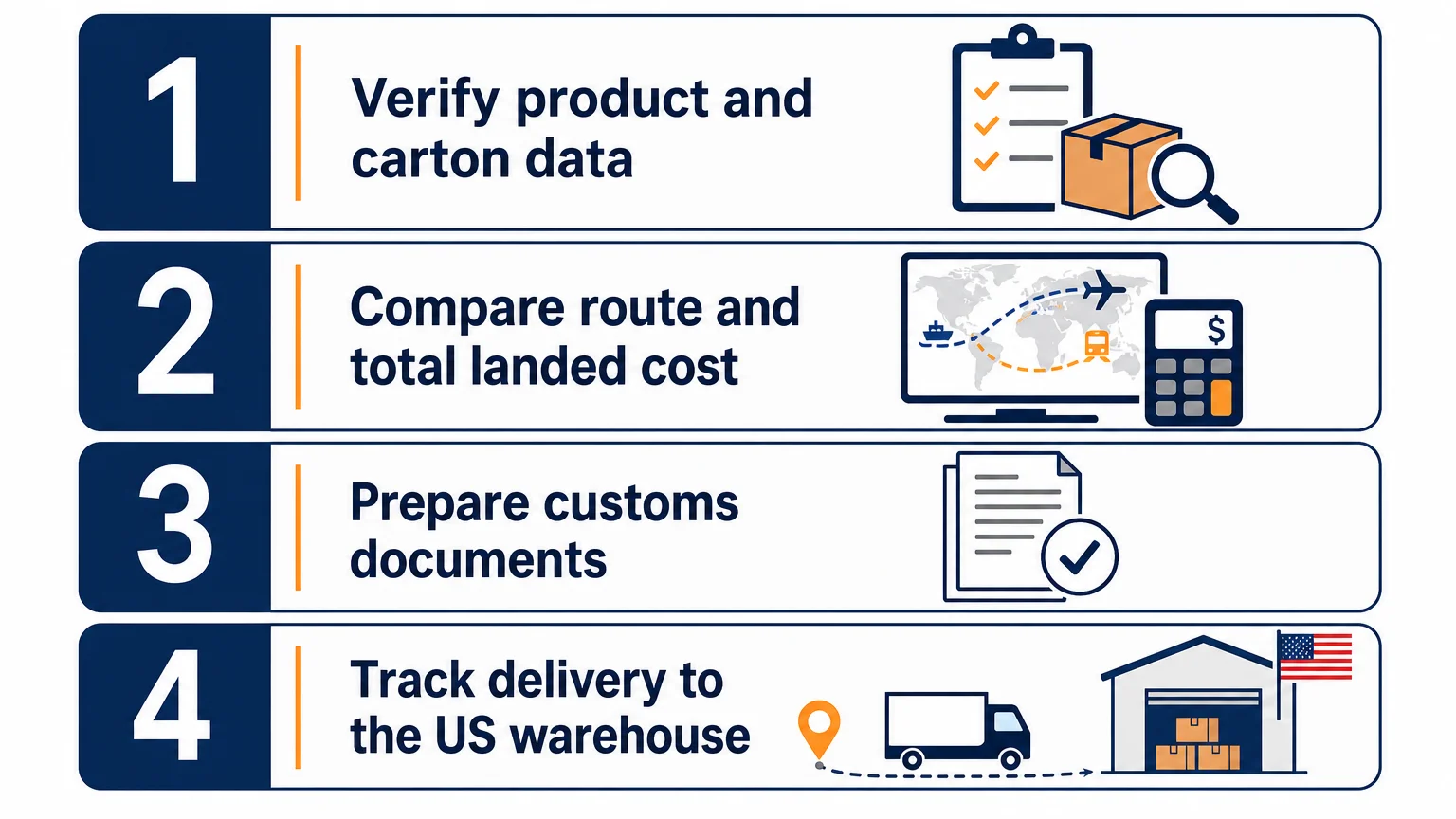
- Collect shipment data. Prepare the supplier address, product description, quantities, carton count, gross weight, dimensions, product value, and destination information. A packing list can contain the core product details needed for initial route comparison.
- Check product suitability. Identify batteries, liquids, chemicals, food, cosmetics, electronics, or other characteristics that may affect transport and customs. Confirm whether additional documents or handling conditions apply.
- Compare three routes. Review air, fast boat, ocean, or another suitable route according to urgency, volume, budget, and destination. Compare the complete quoted cost, not only the international freight line.
- Confirm the delivery structure. Decide whether you need port-to-port, airport-to-door, or DDP door-to-door service. Clarify who handles customs clearance, duties, taxes, and inland delivery.
- Prepare the shipment. Ensure packaging, carton information, labels, commercial documents, and Amazon shipment details are consistent before pickup. Errors at this stage can create delays later.
- Track milestones. Monitor collection, export handling, departure, arrival, customs clearance, domestic delivery, and warehouse receipt. Ask for prompt updates if the shipment moves outside the estimated window.
Our packing-list upload accepts PNG, JPG, WEBP, PDF, and XLSX files up to 10 MB. The form can automatically extract product details from supported files, while WhatsApp and the website quote process also accept product information.
Delivery periods remain estimates rather than guarantees. Air is positioned at approximately 5 to 9 days, fast boat at approximately 22 to 28 days, and ocean freight at approximately 30 to 40 days for the relevant service positioning. Actual timing can change because of cargo readiness, customs, port operations, weather, capacity, and Amazon receiving conditions.
Choose the route that protects your inventory plan
The best mainland China to US shipping method depends on the relationship between urgency, shipment scale, product characteristics, customs responsibility, and final delivery location. Express and air services support urgent, smaller, or higher-value cargo. Fast boat can balance recurring replenishment needs, while ocean freight is generally better suited to larger planned volumes. DDP door-to-door service can reduce administrative work, but the quote must still be based on accurate product and shipment information. For Amazon sellers, the most reliable decision is the one that protects both margin and stock availability. In practice, that means comparing complete landed costs, allowing a realistic buffer, and selecting a route that matches your replenishment cycle.
Get a Clear China to US Shipping Plan
If you are preparing an FBA shipment from a mainland Chinese supplier, the next step is to compare realistic route options before cargo is ready. Accurate weight, dimensions, product details, and destination information allow us to build a practical quote.
Our China-to-US freight forwarding services coordinate supplier pickup, air, fast boat, or ocean freight, Chinese export declaration, DDP customs handling, duties and taxes, door-to-door delivery, tracking, and shipment support. Submit your product information or packing list to receive three route options with estimated pricing and timelines within 24 hours.
Frequently Asked Questions
What is the cheapest way to ship goods from mainland China to the US?
Ocean freight is generally the most economical choice for large, heavy, or non-urgent shipments. The final cost depends on volume, container utilization, destination, customs charges, inland delivery, and whether you use LCL or FCL.
How long does shipping from mainland China to the US take?
Timing depends on the freight mode, route, cargo readiness, customs, and final delivery point. Air is normally used for urgent inventory, while fast boat and ocean services require longer planning windows.
Is DDP suitable for Amazon FBA shipments?
DDP can suit sellers who want one provider to coordinate customs, duties, taxes, and delivery to an Amazon warehouse. You should still confirm product eligibility, documentation, shipment labeling, and the exact scope of the quote before booking.
What documents are needed for a China to US commercial shipment?
A commercial invoice, packing list, and transport document are commonly required. Product-specific permits, certificates, or compliance records may also apply depending on the goods and their intended use.
How can QG Horizon help with an FBA shipment?
We coordinate supplier pickup, international freight, export declaration, customs handling, DDP duties and taxes, delivery, tracking, and shipment support. Sellers can submit product details through WhatsApp, the website, or a supported packing-list file for route comparison.
Ready to Optimize Your Amazon Shipping?
Get 3 route options tailored to your products and timeline
Get Your Quote→