FCA Incoterms Explained: Free Carrier Rules for Importers
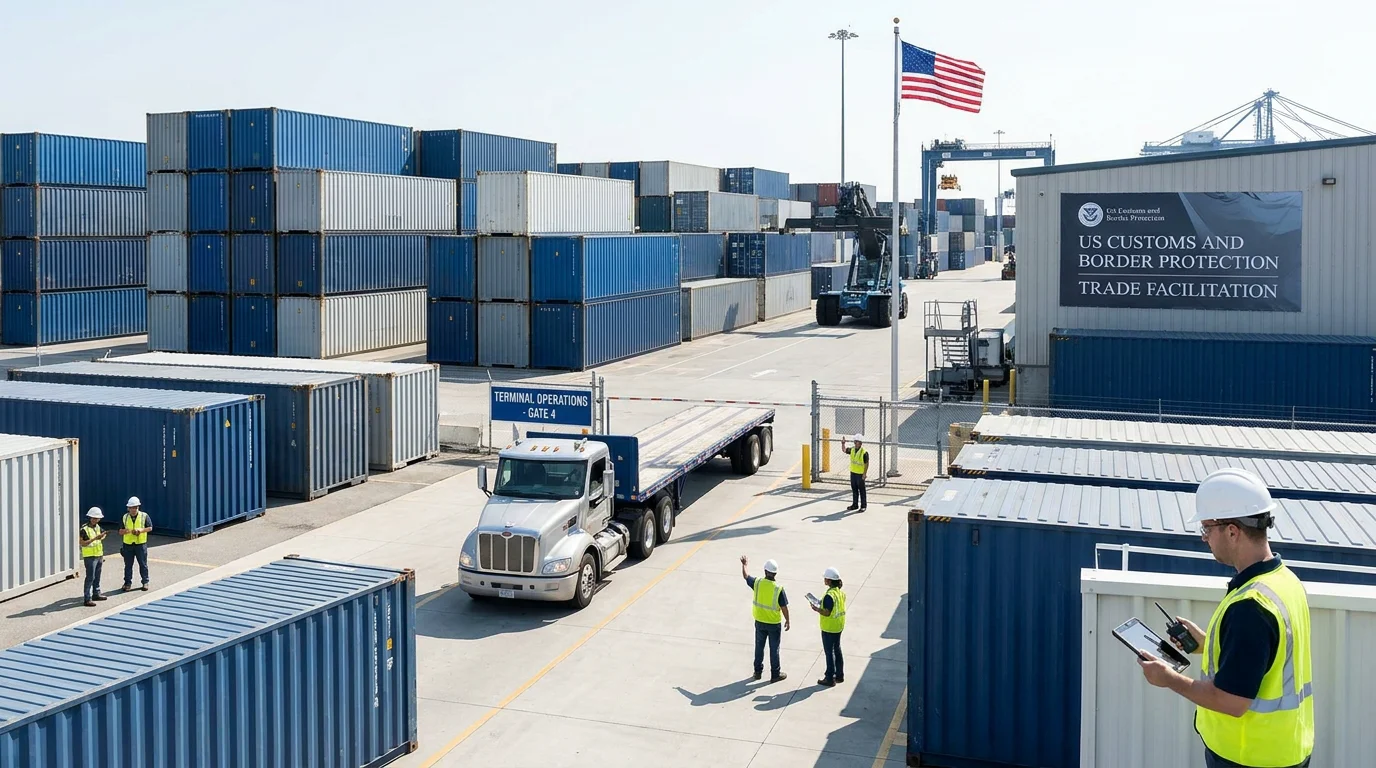
Summary: FCA (Free Carrier) requires the seller to deliver goods, export-cleared, to the buyer’s carrier at a named place, where all risk and cost transfer to the buyer.
Choosing the wrong Incoterm can turn a profitable import shipment into an expensive dispute. Among the eleven rules published by the International Chamber of Commerce (ICC), the FCA Incoterm (Free Carrier) stands out for its flexibility and balanced division of responsibilities. Whether you are sourcing goods from China for Amazon FBA or managing container imports into the US, understanding how FCA works is essential to controlling costs and minimizing risk. For a broader view of how trade terms interact with FBA logistics, see our guide on Incoterms 2026 key updates for Amazon FBA sellers.
Despite its practical advantages, terms FCA remain widely misunderstood. Common pitfalls persist, including ambiguous named places, late carrier nominations, and overlooked terminal fees. This article breaks down every obligation, compares FCA with competing rules, and offers actionable advice so you can negotiate contracts with confidence.
What Does FCA Mean in International Shipping?
FCA (Free Carrier) is an international shipping term where the seller delivers goods to a carrier chosen by the buyer at a specified location, and from that moment the buyer takes on all further costs and risk. Published by the International Chamber of Commerce (ICC) as one of eleven Incoterms 2020 rules, FCA works for every mode of transport and is one of the most commonly used terms in global trade contracts.
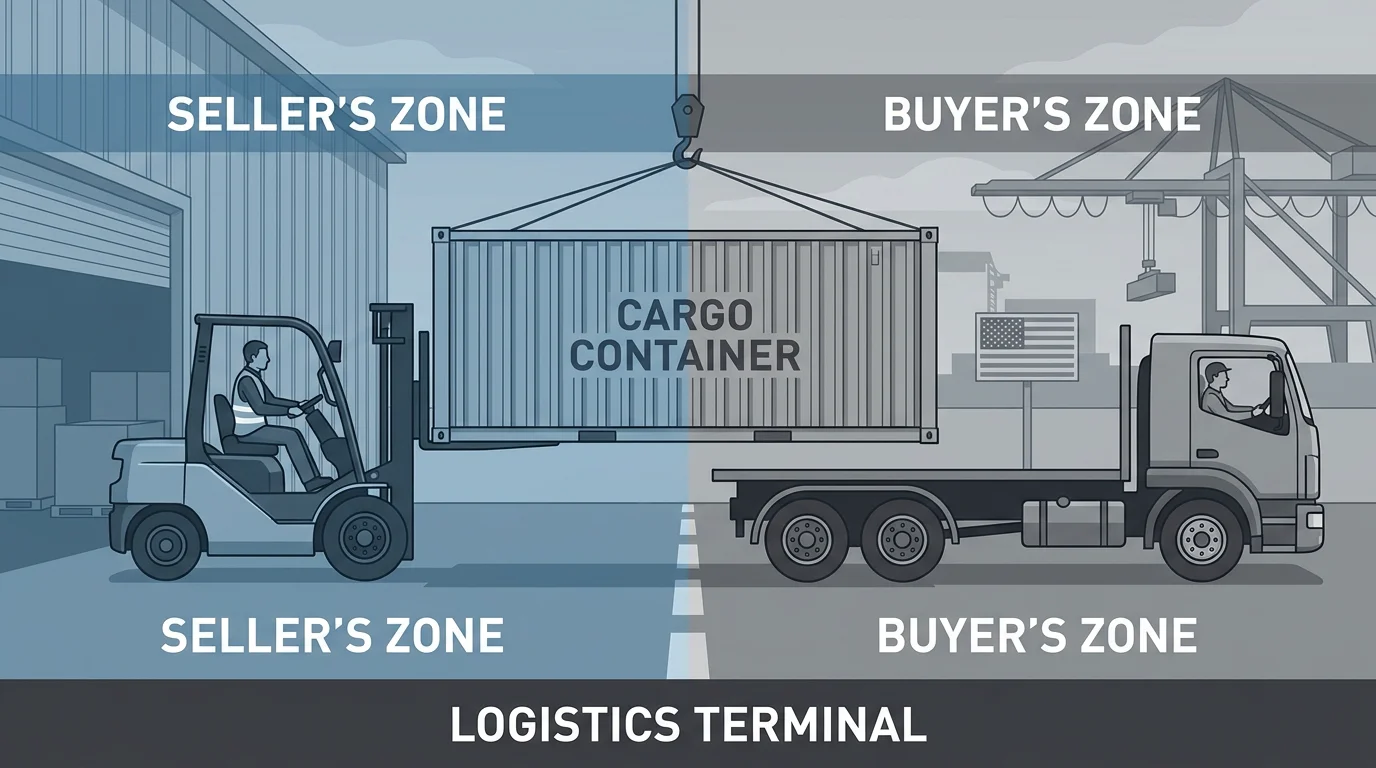
FCA stands for Free Carrier. The “free” refers to the seller’s obligation to deliver the goods free of charge to a carrier or other person the buyer designates. Once the seller hands over the goods at the agreed location, the buyer owns the risk and cost of moving them to their final destination.
While searches for “FCA Incoterms 2023” persist online, the latest version remains Incoterms 2020, effective since January 1, 2020, with no official updates through 2026 per ICC sources. This means the rules described in this article reflect the current global standard.
Why the Named Place Is the Most Important Detail
Everything in an FCA contract revolves around the “named place.” This is the specific location written into the contract where the seller’s responsibility ends and the buyer’s begins. Getting it right matters more than most parties realize, because the named place determines not just where risk transfers but also who handles loading.
Two scenarios apply:
- Named place is the seller’s premises: If the named place is the seller’s own factory, warehouse, or loading dock, the seller must load the goods onto the buyer’s carrier vehicle.
- Named place is another location: If the contract names a freight terminal, port warehouse, or any location other than the seller’s premises, the seller must transport the goods there at their own cost. However, the seller does not unload. Risk transfers when the goods arrive at the named place on the seller’s vehicle, ready for the buyer’s carrier to collect.
As iContainers notes, specifying “FCA Shenzhen” alone is ambiguous; a full street address should be used. For US importers buying from Chinese suppliers, writing something like “FCA [Exact Factory Address], Shenzhen, Incoterms 2020” eliminates costly gray areas.
Seller and Buyer Obligations Under FCA
A clear understanding of who does what prevents disputes before they arise. The table below summarizes the division of responsibilities.
| Obligation | Seller | Buyer |
|---|---|---|
| Export packaging and marking | Yes | No |
| Export licenses and customs clearance | Yes | No |
| Delivery to named place | Yes | No |
| Loading at seller’s premises | Yes (if named place is seller’s site) | No |
| Main carriage (ocean, air, rail, road) | No | Yes |
| Cargo insurance during transit | No (optional) | No (optional, but recommended) |
| Import customs clearance, duties, taxes | No | Yes |
| Delivery from port to final destination | No | Yes |
The seller does not arrange or pay for the main carriage, does not handle import clearance, and has no obligation to insure the goods for transit. As LegalClarity explains, Incoterms impose no mandatory cargo insurance requirement. A clearly drafted sales contract should spell out who buys which policy to avoid gaps.
If you are an Amazon FBA seller weighing whether to handle import duties yourself or let your forwarder manage them, our comparison of DDP vs FOB for Amazon FBA from China offers a side-by-side breakdown.
FCA vs FOB vs EXW: Choosing the Right Incoterm
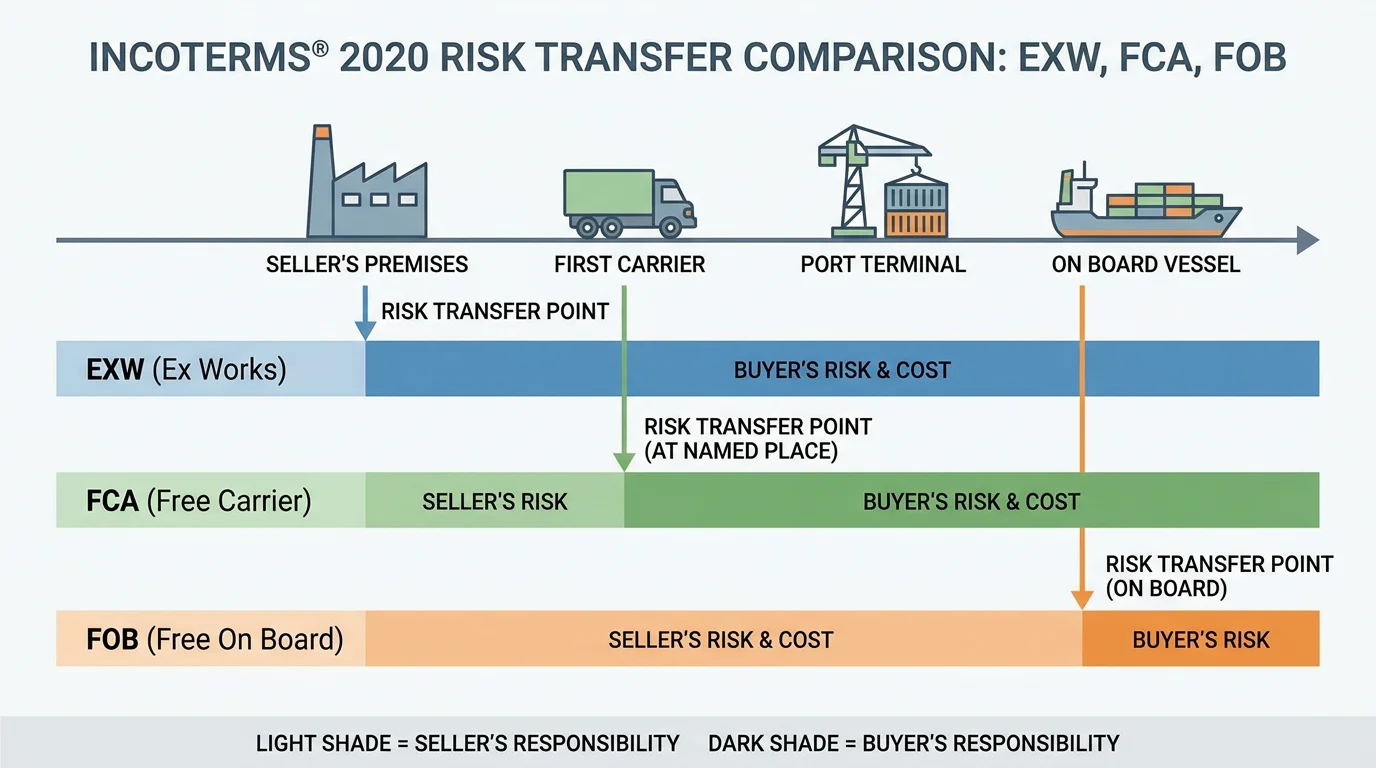
FCA is often confused with FOB (Free on Board) and EXW (Ex Works). Each rule places the dividing line between seller and buyer responsibility at a different point.
| Criterion | EXW | FCA | FOB | DDP (QG Horizon specialty) |
|---|---|---|---|---|
| Transport modes | Any | Any | Sea and inland waterway only | Any |
| Export clearance | Buyer | Seller | Seller | Seller |
| Risk transfer point | Seller’s premises | Named place (flexible) | On board the vessel | Buyer’s final destination |
| Main carriage | Buyer | Buyer | Buyer | Seller |
| Import duties and taxes | Buyer | Buyer | Buyer | Seller (included) |
| Buyer control over logistics | Highest | High | Moderate | Lowest (turnkey) |
FCA is recommended for containerized freight. It overcomes the disadvantages of EXW, where the buyer is in a worse position than the seller for arranging local transport and customs. Under FOB, the seller is responsible for loading the cargo onto the vessel, but with FCA, it is the buyer’s responsibility. FCA risk transfer takes place at an agreed-upon point, whereas with FOB, the buyer assumes the risk on the vessel.
The ICC officially recommends FCA over EXW for cross-border transactions because FCA puts export clearance on the seller, creating a cleaner regulatory placement. For US businesses importing from China, this means your supplier handles Chinese export formalities, which is typically more efficient than trying to manage them from abroad.
For a deeper dive into how FOB and other terms compare for Amazon FBA shipments, see our resource on FOB vs CIF vs DDP: choosing the best Incoterm for Amazon FBA.
The Bill of Lading Update in Incoterms 2020
One of the most significant changes in Incoterms 2020 directly affects FCA transactions financed through letters of credit (LCs).
Article A6/B6 now lets the parties agree that the buyer instructs the carrier to issue an on-board bill of lading to the seller once the goods are loaded, making FCA more attractive for letter-of-credit trades. Before 2020, sellers using FCA struggled to obtain this document because the carrier had no contractual obligation toward the seller.
There is an important caveat. Under the Incoterms 2020 revision, the seller can (at the buyer’s request and cost) instruct the carrier to issue an on-board bill of lading marked as loaded, which is important when the buyer has a letter of credit that requires an on-board BL. However, the carrier is still not legally obligated to comply, so timing delays can still occur.
For US importers using LC financing, it is advisable to address this requirement explicitly in the sales contract and coordinate with the freight forwarder early in the process.
Common FCA Pitfalls and How to Avoid Them
In China-EU lanes, delays from unclear instructions affect 20 to 30 percent of deals, according to logistics reports. While this figure comes from China-to-Europe trade, similar problems affect US-bound shipments. Here are the most frequent mistakes and their remedies.
- Vague named place: Writing “FCA China” or “FCA Shanghai” without a precise address leaves room for disputes about who pays inland transport. Always include the full street address.
- Late carrier nomination: Ambiguous named places, late carrier nominations, and overlooked terminal fees are recurring issues. Buyers should confirm their carrier details with the seller well before the cargo is ready.
- Overlooked terminal handling charges: When the named place is a freight terminal (not the seller’s premises), unloading costs fall on the buyer. Factor these into your landed cost calculation.
- No insurance: Neither party is required to insure the goods under FCA, yet risk transfers early. Buyers should arrange cargo insurance from the named place onward.
These risks are precisely why many Amazon FBA sellers opt for a DDP (Delivered Duty Paid) arrangement, where the freight forwarder handles everything from factory to warehouse. We manage the entire process so you know your total cost upfront and avoid surprises at customs.
When FCA Makes Sense for US Importers
When buyers routinely purchase containerized goods and they have an established third-party logistics company or freight forwarder they can rely on, FCA can be an advantageous Incoterm. Specifically, FCA is a strong choice when:
- You ship containerized cargo and want to negotiate your own freight rates.
- You have a trusted freight forwarder who can manage the main carriage efficiently.
- Your supplier is comfortable with handling export clearance in the origin country.
- You do not rely on letters of credit (or have addressed the on-board BL issue contractually).
However, if you prefer an all-inclusive rate that covers duties, taxes, and delivery to your Amazon warehouse, a DDP solution removes the operational burden entirely. For a detailed side-by-side analysis, review our guide on FOB shipping point vs FOB destination explained.
FCA and the Rise of Digital Trade Documentation
Digital shifts amplify FCA’s strengths: electronic bill of lading (e-B/L) adoption, emphasized in 2024 ICC Academy updates, streamlines proofs. No core Incoterms changes have occurred post-2020, but electronic documents enhance efficiency.
With blockchain-based documents and AI-powered customs processing, FCA adoption grows. Sustainability mandates also favor flexible terms like FCA for green routing. As highlighted by FreightAmigo’s 2026 logistics guide, buyers increasingly nominate specialized carriers for ESG-compliant routes, a trend that aligns well with FCA’s structure.
For US importers, the practical takeaway is clear: digital documentation reduces processing time, lowers the risk of lost paperwork, and accelerates customs clearance on both ends of the supply chain.
At QG Horizon, we integrate real-time shipment tracking and streamlined customs documentation into every shipment, whether you choose FCA, FOB, or our preferred DDP arrangement. Our team based in Shenzhen coordinates directly with your supplier so that documents are prepared correctly from day one.
Conclusion
The FCA Incoterm offers a balanced, flexible framework for international trade. It places export clearance on the seller, gives the buyer control over the main carriage, and works across every transport mode. Yet that flexibility demands precision: a vague named place or a missing insurance clause can quickly erode the savings you expected. With up to 30 percent of China-outbound shipments affected by unclear FCA instructions, the stakes are too high to leave contract language to chance.
Whether FCA or DDP is the right fit depends on your experience, your freight volumes, and your appetite for managing logistics details. We simplify that decision by offering a single point of contact from factory pickup through customs clearance and final delivery to Amazon warehouses, with duties and taxes included so there are no surprises. To find out exactly what your next shipment will cost, request a free quote from our freight specialists and let us handle the complexity for you.
Frequently Asked Questions
Is FCA suitable for Amazon FBA shipments from China?
FCA can work if you have a reliable freight forwarder to manage the main carriage and import clearance. However, many FBA sellers prefer DDP because it bundles all costs into one predictable rate. At QG Horizon, we offer DDP shipping with duties and taxes included, which eliminates the guesswork that FCA leaves on the buyer’s side.
Who pays for cargo insurance under FCA?
Neither party is contractually required to purchase insurance. In practice, the buyer should arrange coverage from the named place onward, since all transit risk falls on the buyer once the carrier takes possession. Always specify insurance responsibilities explicitly in the sales contract.
Can FCA be used for air freight and rail shipments?
Yes. Unlike FOB, which applies only to sea and inland waterway transport, FCA is valid for any mode of transport, including air, rail, road, and multimodal combinations. This versatility makes it especially popular for time-sensitive shipments and intermodal logistics.
Ready to Optimize Your Amazon Shipping?
Get 3 route options tailored to your products and timeline
Get Your Quote→